
How We Build the Evolved Nest We Need to Thrive with Dr. Darcia Narvaez
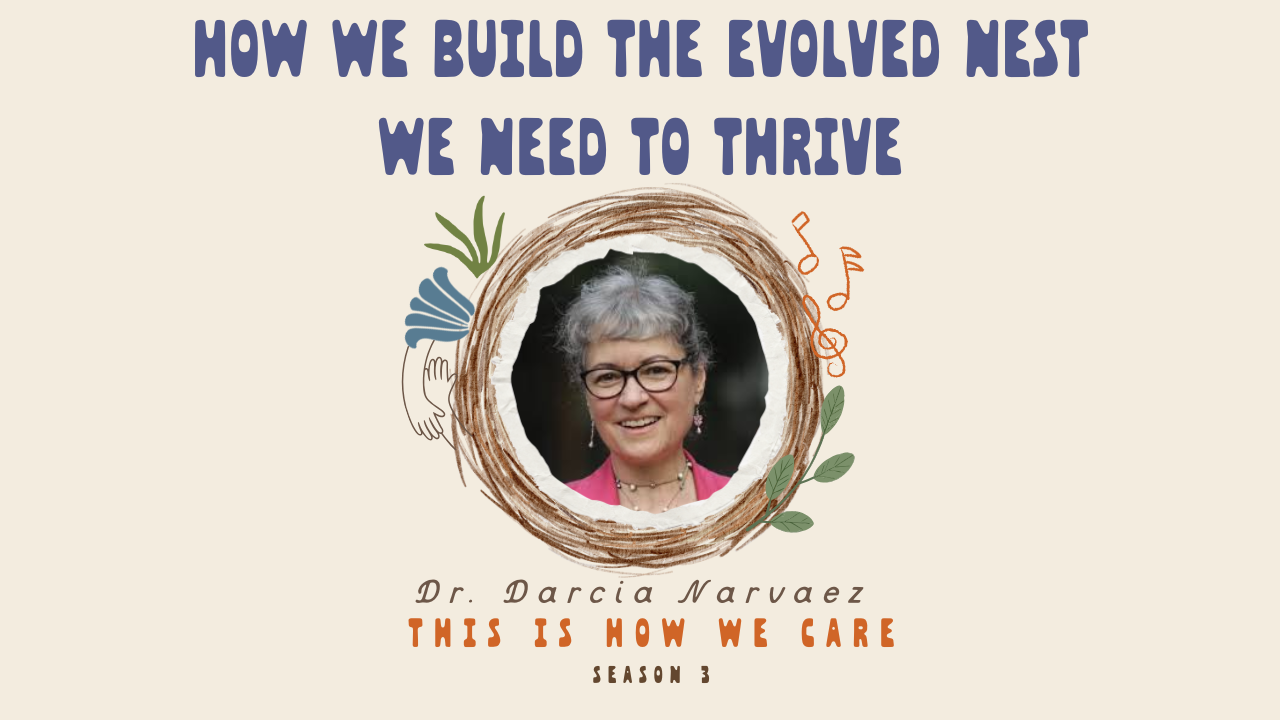
Collage image of Dr. Darcia Narvaez photo, sitting in an image of a birds nest, images of the icon for “relationships” (blue flower), green plants, three red music notes, a drawing of hands in an embrace. Text reads “HOW WE BUILD THE EVOLVED NEST WE NEED TO THRIVE” Dr. Darcia Narvaez This is how we care Season 3
In this episode of This Is How We Care, we sit down with developmental psychologist and author Dr. Darcia Narvaez to explore what children—and humanity—truly need to thrive.
Drawing from neuroscience, anthropology, Indigenous wisdom, and decades of research, Dr. Narvaez introduces the concept of the Evolved Nest: the caregiving system humans evolved with for 99% of our history—and how far modern culture has drifted from it.
Together, Emily and Darcia unpack how early “undercare” shapes everything from individual anxiety to collective violence, how capitalism and colonization disrupted our natural caregiving systems, and what it looks like to return—without shame—to a more connected, communal, and life-affirming way of raising children.
This conversation weaves together science, spirituality, grief, and hope, offering practical, everyday ways to begin re-nesting ourselves, our families, and our communities—starting now.
This episode covers:
What the Evolved Nest actually is (and why babyhood matters so much)
How “undercare” shapes adult disconnection, greed, and burnout
The role of touch, play, breastfeeding, and communal caregiving
Why nature connection and music are essential to human regulation
How the “Wetiko” mindset took hold—and how we heal it
Why children (and adults) need to be welcomed, not given “independence training”
How to begin rebuilding village even inside modern life
This episode is an invitation to remember who we are, what we need, and the kind of world our children are asking us to build.
To Connect with Dr. Narvaez:
Website: https://nestedworld.org/
Become a “Nesting Ambassador”
Read “The Evolved Nest”
To Work with Emily — the Revillaging Mama:
Revillage Your Life – A 4-month mentorship container to transform your experience from “isolated” to “supported”, bringing to life much of what Darcia speaks about in the importance of community and village
The Third Space – A community of revillagers bringing the village to life through practice, prayer and play
BOOK A FREE DISCOVERY CALL to explore the next layer of support for your revillaging journey
Transcript
Emily Race-Newmark (00:10)
Hello and welcome to This is How We Care, a podcast that is imagining what kind of world our children want to inherit and how we, the village raising them can embody that world. I’m your host, Emily Race-Newmark.
Today you are joining me in the middle of my winter, our winter, if you’re in the Northern Hemisphere. And it’s also my inner winter because I’ve really been intentionally leaning into this season, the season that surrounds me in the external world, to also guide me and serve as a teacher for this inner call I’m feeling to rest, to hibernate, to take things slowly.
And this is really all a part of like a many year practice that I have been calling in for myself to live more cyclically and in tune with the seasons, which is actually really beautifully connected to the conversation that I’m here to share with you today with Dr. Darcia Narvaez, because so much of what she’s going to talk to us about is about coming back to our true nature as a species, as a human species.
Dr. Narvaez is the author of two amazing books, which I have with me here. One is called Restoring the Kinship Worldview, which centers indigenous wisdom and voices for how we could rebalance life on planet earth. This was the first book I had read from Darcia that really landed with me on a deep soul level, as a part of truth that is really missing from our mainstream dominant culture.
I knew after reading this book that I wanted to interview Darcia, but it was the second book I read of Darcia’s, The Evolved Nest, that we really focus on today. In this book, Dr. Narvaez and her co-author are really examining all these different species— from wolves to elephants, to bears, to the human species— and from this lens, they provide a perspective on how we, as an animal species, within this animal kingdom, are meant to raise our young, to grow an age and learn and develop and care for one another.
If there was any conversation that’s almost “foundational” to what This Is How We Care is about, I would say it’s this one with Dr. Narvaez, and I’m so excited to share it with you today. So, I am emerging from my inner winter hibernation to get this episode out to you all, and I hope that you enjoy it as much as I did.
A bit more about Darcia, if you’re curious to know — she is the Professor Emerita of Psychology at the University of Notre Dame, and here she uses an interdisciplinary approach to studying child development and human flourishing.
Her recent books, as I mentioned, include Restoring the Kinship Worldview and The Evolved Nest. These are amazing resources. Highly recommend having them on your shelves.
And she has some recent short films, including Breaking the Cycle, The Evolved Nest, and Reimagining Humanity, if you prefer to check out some of this learning that way. You can check out all of her work and more at thenestedworld.org.
Is there anything else I want to tell you before we jump to this episode? I don’t think so. I think we should just jump right in and hear from Darcia herself. This conversation is really full, so I hope that you’re able to take the time to listen to it in its entirety, start and pick back up when you need to, but do not miss out on this conversation. It really brings us back to the root of who we are and what we need to thrive as a species, and of course, the role that community plays.
I look forward to hearing what you think. Without further ado, let’s take it over to Darcia.
Dr. Darcia Narvaez (03:21)
My earliest memory is of injustice towards children in my household, but also I spent half my childhood living outside the United States. Every third year, we’d go away for a year and come back for two and go away for a year and come back for two. And it was to Spanish-speaking countries, and several of which were so-called third-world countries, where I would see children my age —I’m being driven in a school uniform to school — and I would see these children on the street corner in rags barefoot selling gum, right, which of course for their dinner — which I didn’t really put that together [at the time] — but I thought “why are they there and I’m here?”
And then I would come back to the States and see the overabundance and the waste and the privileges that we have ⁓ that I had as a kid. I couldn’t understand what was wrong with the world.
That plagued me, because I would cry over those children’s experience and I barely knew what that meant, even.
Now I know that they probably had a lot more love than the typical family has time for in the States because they’re more indigenous, more close to the earth, less distracted by all sorts of things, and they probably followed evolved nest ways in so many ways. But at the time, it was unbelievable, and that plagued me for my life.
It took me a little while to try to answer the question. I had different careers. I was a musician and had my own business, was a classroom teacher of music, classroom teacher of Spanish, at different times. I went to Seminary to try to figure out if they had the answer and then finally found the field of moral development and I thought, “Aha! This is going to help answer that question”
Well, that field didn’t quite do it either. I had to go exploring and read widely in anthropology and neuroscience and effective neuroscience with animal science and interpersonal neurobiology and all that stuff, bringing it all together.
The Evolved Nest popped out as a transdisciplinary insight. I’m giving you the very short kind of nutshell of how I got here.
Emily Race-Newmark (05:43)
I’m hearing you got here through your heart and you got here through a child’s view of the world, which I think is a lot of what we’ll be talking about today, speaking to caregivers, those who are caring for the next generations.
And I’ll speak for myself; the minute I became a mother and even preceding that, I really was transforming my lens, starting to break apart this illusion of the “individual”, and then finding the contrast in this Westernized culture, the colonized worldview that I’ve been drinking the “KoolAid” of as long as can remember.
So thank you to little Darcia who had that question that led you here today, because I think the work that you’re really amplifying is so needed and we’re hungry for it even if we don’t realize it.
Darcia Narvaez (06:29)
Yeah, well it’s not been me, it’s been the gift from on high intelligence coming from the wisdom of our ancestors and the cosmos.
Emily Race-Newmark (06:35)
Yes, well, that’s how you know it’s then truth.
I will also share, I’ve been reading The Evolved Nest and I’d love to talk more about breaking apart really what the “Evolved Nest” means, and how we can start to reactivate and reengage in that way of raising children.
Ever since picking up the book, I have been deeply, deeply in relationship with the natural world, the birds, the trees, my eyes opening up even more to how they, too, are a part of this idea of a “village” that I know I yearn for. So thank you for that, because I think so often I had been focused on like, “who are the people in my village?” Who are the people?” And forgetting, wait, “who are the more than human kin that have so much to offer?”
So let’s maybe start broad strokes. We’ll get into the Evolved Nest in a moment. But I’d love to amplify your vision for the world, if you could kind of wave a magic wand, what kind of world would you like to give to our collective children?
Darcia Narvaez (07:38)
I would like them all to be raised in multi-generational, multi-age, multi-gender family community groups, where they are free to learn by imitating and observing and imitating and pitching in at will, where their needs are met without question, and where children are in charge of breastfeeding. Breastfeeding is shared among women, which is done in many cultures.
And that play is part of all of every age’s life. It’s not limited to children to play, but all of us play together. And everyone has time to heal. Together when things get disruptive or out of balance, there’s time for community healing practices, the dancing and the singing and the drumming, perhaps, those kinds of things.
I’d like the world of humans then also to pay attention to the ecological community, the bio community around them and to honor them and respect them and treat them as partners rather than as entities to be dominated, future commodities. I mean, that’s very strange and weird for our human species. That’s a recent, hundreds years old kind of perspective.
There’s a lot of things to talk about here, but anyway the big vision is happiness, joyous inner connection, everyone’s basic needs met and feeling like we’re part of earth and we are good partners and we become good ancestors.
Emily Race-Newmark (09:15)
It’s such a beautiful vision. I see it so clearly, feel it so clearly.
And for listeners who are just learning about the evolved nest, would you say more or less that is what the evolved nest is? Could define that real quick?
Darcia Narvaez (09:31)
Yes, so the Evolve Nest is about meeting basic needs throughout life, especially important in babyhood, —which people kind of minimize, you know, “this is all genetic, whatever the child becomes” — it’s very much epigenetic and the plasticity of the trajectory of the child is shaped by their experiences.
For a baby, it’s a 24-7 expectation of conversation, of interaction, of constant presence of nurturers and we forget that but that’s how you build our human nature, which is cooperative naturally compassionate naturally ⁓ forgiving and loving. But if you treat babies as if you only need to pay attention to them once a day, or whatever, make a checklist; “I hugged my child today.” “I spent 10 hours with them, now they can go spend the rest of the day alone.” No, no, no, that’s misunderstanding how humans develop and how vulnerable babies are.
They’re like fetuses of other animals till nearly age two. And so they need to be treated like they have an external womb, like their needs are met immediately.
There’s various phases of that to be really attentive in babyhood, but then when they want to move around to stand back and let them explore and don’t interfere unless there’s some emergency, but otherwise, this is how you build a very independent, strong, confident human being.
If you interfere along the way, you’re going to have a unconfident person who has to look externally for what to do because you’ve broken the inner compass. There’s an inner compass towards wellness, an inner compass towards connection, intercompass towards developing all sorts of intelligences to live well on earth, and once you start to punish or not provide the needed responsiveness, or you interfere and say “don’t do that, that’s dangerous”, you’ve now undermined their confidence and it affects them for the rest of their lives.
I could say keep going…
Emily Race-Newmark (11:48)
Well, please keep going, but something came bubbling up for me— and I’m gonna need your support in finding the name— but in Restoring the Kinship Worldview, there was a conversation about the sickness, is it called “Wetkio”?
Darcia Narvaez (12:01)
Yah, “wetiko.”
Emily Race-Newmark (12:03)
Wetiko. What’s coming to mind is what you’re speaking of feels intuitively like, yes. And then there’s this sickness I feel like we have that has separated us from that way of showing up from us even seeing that as what’s natural.
So yeah, if you want to just speak to at all, what has contributed to this separation from what’s natural? I’d love to just touch on that briefly.
Darcia Narvaez (12:30)
Wetiko refers to this insatiable greed to consume or cannibalize life. And that’s just been part of the explorers, colonizers, capitalists, globalization people for the last few hundred years.
And it comes about, I think, from that early childhood experience of not getting your needs met and feeling like there’s never enough.
Especially for boys — I should say, boys need a lot more nurturing than girls. Boys have less built-in resilience. They mature more slowly by about two years until age 30 or so. And they’re more easily traumatized by social humiliation. And so we can see how males have become especially susceptible to the Wetiko.
So in my view, we’ve fallen into this Wetiko virus, which is now spread across the planet, because the dominant culture of globalization has forced mothers not to mother, not to nurture.
Families can’t nurture. They’re just put into almost a slave-like experience.
So then the Witeko virus has become so widespread, we think it’s normal. It gets normal for people to be selfish, aggressive, ruthless, you know, to get their own. And so then we have politicians who act that way and they get elected because people feel that they’re going to “get what they want” from this person who’s going to lead the way. But people have a lot of sadness, grief… a sense of injustice from the under care, [which is] a lack of the evolved nest in early life.
And if you’re in, for example, a white supremacist family, you blame, then, “those other people”, the immigrants, the whatever-minority-person-group you want to as part of whatever culture that is.
And then your anger goes towards them, not towards your parents who haven’t provided…but then really it’s the community.
Dr. Darcia Narvaez:
The nest is a communal responsibility. The parents can’t do it by themselves. It’s a village. It takes a village to raise the child. And so we tend to blame moms, you know. And the moms are doing the best they can.
And then they have generations where they were not nurtured. So they don’t even know maybe how to nurture and love a baby with a nest because they weren’t. And before that, before that.
Also we’ve shrunk down the ability of all of us to nurture one another and be nested by the structures — and then the superstructures, we call them “the narratives”, the cultures, myths, beliefs… “this is the way it is”, “babies, you have to teach them independence”, you know, “it’s not going to hurt them if you leave them to cry” — myths. All the science is against that.
But people are caught they’re caught in the stories, they’re caught in the structures, they don’t support them, and then what can they do? They minimize to try to feel okay about what they can do, and they minimize the needs of the baby.
Emily Race-Newmark (15:56)
Yeah, there’s so much of what you just said that I want to underline. I mean, first, to go back a bit to what you said about the developmental differences between girls and boys and what boys really need in terms of nurture. My heart breaks seeing the contrast of that.
And then also the scapegoating — I’m feeling the “scapegoating” energy of looking for someone to blame.
What I’m really seeing is in what you’re talking about, there’s a call to return to something. There’s a call to return to something that we all actually could dig deep and probably find the original coding in our DNA, if we dig back… but at the same time, trying to survive in this system that it’s very much run by pulling us apart, needing to get out to work.
In our home, we have done almost everything we can possibly think of to create this evolved nest, to call in the village. And yet, there’s still the pull of, “I have to go make the money to pay for this”.
What I’d love to hone in on here is for listeners who are like, “yes, I want to be a part of bringing the Evolved Nest back”, what are some ways that we can do that? And especially if we’ve never seen it for ourselves.
Where would you offer to begin? What would be a starting place into returning?
Darcia Narvaez (17:12)
Maybe we should talk about what the evolved components are.
The first one now is the welcoming social climate. That means when the mom is pregnant, and even before conception, there’s a welcomingness, a lovingness, ⁓ a sense of belonging between the parents and then the mother who’s pregnant, the baby’s wanted, communicates love, and the community supports the mother and child and wants that baby and communicates love as well.
But we need welcoming throughout life. When we’re with our family or with the community members, we want to feel like we matter, like we belong, like people are listening to us, that we can unfold our uniqueness, our unique gifts that each of us have.
So welcoming is something that we need all lifelong, and that we can do then on a daily basis. We can ask each other, “how are you today?” and really listen. We can ask, “how can I help you feel like you matter today?”
And so it depends on the age of the person we’re talking about, but to always high five them when they show up or give them a hug or have some routine of welcoming that you develop together, do a little dance, whatever it is.
Ensure the connection, the connectedness. Right now, you’re present with one another and now you can actually electrically feel that across the distance you are.
Emily Race-Newmark (18:50)
Can I touch on that, for a moment — what’s so beautiful is, imagining that peice within birth.
I also have really been focusing on what does it look like to welcome more elders into my village, because there’s so much separation, and it’s a role that I am craving. And I live on a street with a lot of “elder-y” people, where it’s like, what would it look like not to rush past each other, but pause and leave space in our days for that?
So again, the tension is when we live in a culture that is so focused on the hurriedness and the rushing, and there’s always a place to get to, it is a practice to slow down enough to welcome one another. What have you found to be supportive in that?
Darcia Narvaez (19:32)
Well, if you’re talking about elders, young children are very good at approaching and moving in slower ways with the elders.
Depending on how old you’re talking about, preparing the child and say, “we’re going to go visit the neighbor and take them a gift today. What kind of gift should we give them?”
And you prepare and you can follow holiday gifts. We used to do this when I was a child. We’d prepare cookies for the different families in the neighborhood at Easter and at Christmas and even sometimes 4th of July. And so just always trying to find a way to connect. And it doesn’t have to be a physical gift. It can just be a gathering, you know, to bring and invite them over. “We’re going to have a party and we’d like to celebrate X or Y and we’d like to have you join us.”
Now maybe people are shy, so then you have to be more encouraging in different ways. Go up and talk to them on the street or at their house, somehow at the door, and get them feeling comfortable with you.
There’s a lot of distrust now, our media just fosters that even before social media; the more television you watch, the more likely you are — and this is before social media the more likely you are to believe the world’s a dangerous place and you’re less sensitive to victimization and you tend to be more aggressive. So that’s the findings from television. And that’s from a few decades ago before it was so violent. Now you can find all sorts of terrible things on television. So people get very afraid and then social media of course is making everyone afraid.
I had a neighbor ~ I walked around and gave Christmas treats to neighbors this past Christmas and I walked up and rang the doorbell of one neighbor and she had an intercom and she yelled at me and said, “get away from the door,” I don’t know, whatever and it was like, she was very afraid… and I said, “well, this is Darcia I’m coming from across the street just to give you a Christmas treat”, and then she came to the door and apologized because she said she had been watching some CSI or something on TV and you know she thought...
So it’s everywhere that way now in the States because we don’t control violence on the media.
Emily Race-Newmark (21:52)
Yes, yes.
Yeah, the listeners who have been following along for a while will know that baking things is one of my favorite ways to connect with neighbors. I see it as a form of economy and like a gift economy and sense of like, I’m giving this out of joy and it really does create more giving.
So, welcoming, that’s such a beautiful piece. Talk to us about another aspect of the Evolved Nest.
Darcia Narvaez (22:03)
Well, we mentioned a little bit the soothing perinatal experience, so that the mother feels supported during pregnancy, that birth is soothing and not rushed.
Babies vary by how long they stay in the womb, by about 55 days. And so you want to give them the choice of when to start to exit. Hopefully the mother is not stressed because that is linked to early childbirth.
You want that birth to be gentle, following the rhythms of the mother and child. It might take several days because the baby sort of inches out and then inches back. It’s like, “oh, do I want to get out there? I don’t know.” But the medicalized birth rushes everything along. So drugs are used and the baby gets drugged and can’t connect, can’t bond because they can’t process the drugs from the mother’s labor; epidural, pitocin, artificial oxytocin, all that just interferes with the normal hormones, makes it hard to bond for mom and baby, makes the mom have trouble breastfeeding because of the artificial oxytocin, all sorts of things get out of rhythm. So that’s not a soothing birth.
And then after birth, you want to have skin-to-skin contact with mom as soon as possible.
You want the umbilical cord to not be cut for like 15 minutes because it’s transferring all sorts of good things to the baby stem cells, iron, oxygen and the baby needs that and then the baby if allowed to will crawl up the mom’s belly and manipulate the nipple and start the milk flow.
Talk about feeling empowered. What a way to start your life, right?
Emily Race-Newmark (24:06)
Yeah, yeah. I really appreciate that part of your book about just extended breastfeeding, breastfeeding in general, and really seeing it as a form of the baby finding its way to safety and comfort and that sense of autonomy, if you will, within this attachment relationship.
And I am someone who has breastfed both my children and has often been met in the culture outside, like, “are you just becoming this human pacifier?” Almost the sense as if I’m overfeeding or just over giving.
Can you talk to us really about what role breastfeeding is playing in an evolved nest?
Darcia Narvaez (24:43)
Breast milk is the magical elixir of life. It’s so amazing. The mom’s body is building the right kind of milk for that baby based on gender, based on the growth spurt, based on whether there’s an infectious agent in the area that she’ll build an antibody.
Morning milk is energizing, evening milk is calming and sleep-inducing. So have to be careful if you’re pumping to label your bottles.
And it’s something that ⁓ is 80 % alive, and so it’s growing the brain in particular, which is growing so quickly, thousands of synapses a second of brain connections. And they need this fuel, the hormonal fuel of breast milk to build the brain well.
And the gut is also being constructed by the breast milk, and that’s where your immune system largely lies. Breast milk has the good bacteria, so it’s building the immunity.
That’s why our species on average, all over the world, in hunter-gatherer civilization, which is 99 % of our history in that kind of society, the weaning age is age four on average.
Emily Race-Newmark (26:11)
Versus, and I read this statistic and was blown away, that by like six months, only 25 % of mothers are breastfeeding .I’m assuming in the United States?
Darcia Narvaez (26:22)
Yeah, at all. Breast feeding at all.
Emily Race-Newmark (26:26)
Yeah, and so both of these things you’re touching on — as someone who’s given birth and has been familiar with the institutionalization of birth — there’s just a lot of fear, right?
And there’s also this a lot of shaming, I want to say, around breastfeeding. There’s a lot of fear around birth itself. So kind of stringing back to your point with “welcoming each other in”, there’s almost like a level of trust we need to cultivate with each other, with our own bodies, our wisdom. What would you expand on this idea of trust that we need to cultivate?
Darcia Narvaez (26:58)
Well, let me just say that trust is being undermined by corporations. It’s the formula companies that lobby against paid parental leave in the United States because they know that if moms have paid leave, they’re going to breastfeed longer, right?
And they’ll lose profits. And so we have to understand then also medicalized birth is all about making money. It’s not about what’s keeping well-being going in the mother and the future of the child. So it’s really hard to trust the corporate-led way we live in the States.
Now in Europe, they have government-funded health care, and they want you to be well because it’s taxpayer money paying if you’re unwell. And so the incentives are correct, whereas in the States, the incentives are all backwards.
So it’s hard to have trust in what the institutions are doing. But if we’re talking about our own lives, just apart from the corporations and perhaps the government’s hand in that, we have to learn to trust our community members, the wise elders — not the elders that were all unnested and they survived and so now they say, “don’t pick up the baby, you’ll spoil the baby” or, you know, “who cares about breast milk? Just feed them formula. Whatever. It’s just as good.”
Oh, it’s a million miles different. Hardly anything, you know. Formula only has a couple dozen ingredients in it. They’re not alive. And they don’t, it’s not even human, much of it, right? Maybe none of it. I mean, they keep changing it. And so then they say, “oh, we have Vitamin D in the milk now. Moms have low Vitamin D.”
Okay, moms need more sun.
“No, no, have formula because it has vitamin D.”
So all these misdirected attention, they take advantage of moms who are vulnerable. They need to be supported and not made to be afraid.
Emily Race-Newmark (28:47)
Yeah.
Can I you about this ~ so I hold in one hand, exactly what you’re saying. The way this lobbying monster that has interfered, intercepted with our own intuition and what is natural.
And then I also have, I’m thinking of a couple of friends who had to go on antidepressant medication, which prevented them from breastfeeding because they stepped into this postpartum window without the support that they needed.
So I think that there’s this area where I feel like I don’t want to shame mothers who have to use formula because they had to take care of their own health. And I want to zoom out and be like, well, why are we in this moment to begin with?
Forget about the mother. What is missing in the fabric? So is there anything in the evolved nest that speaks to support for mother, knowing how important the mother is in this?
Darcia Narvaez (29:51)
Absolutely, yes.
The nest is communal. That means multiple bonded nurturers. They’re attached to that baby. They’re responsive. They’re known by the baby over time, of course. ⁓ And that’s how we evolved to be collective child raisers, not isolated mothers, isolated mom and dad.
No. So that’s another piece that’s so sorely missed in the modern industrialized nations that we separate families from one another that, you know, for all sorts of reasons that was done — not out of what people wanted, but now they do want it because they’ve been raised to be so individualistic because you separate the baby right away at birth. Then they think, ⁓ I’m an individual. Guess I to survive on my own. And then they don’t develop all the physiology for the collectivist wisdom of getting along with other people.
Yes, so collective nurturing is what we need and we need to get back to that. And unfortunately it resides in the hands of the family to figure out how to create your own village with other families, you know, so you can have support where you can maybe meet together as families once a week and cook a bunch of meals and do your laundry and the kids play and the adults have support. Ideally it’s daily all day long.
Emily Race-Newmark (31:14)
My gosh, how beautiful and wonderful would that be? And that’s truly what I’m putting my whole focus and life on at this point, knowing how important, you know, addresses many of the crises of our time.
Darcia Narvaez (31:20)
Yeah.
Emily Race-Newmark (31:25)
Hi there, Emily here. I just wanted to jump in and elaborate on what Darcia is saying and where I might be able to offer you some support.
If you are a parent who’s listening to this, or you’re thinking about starting a family someday and you don’t want to carry the weight of building a village on your own, this is where my work as the Revillaging Mama comes into play.
Through one-on-one and group containers, I support parents and parents-to-be in creating the villages that we were meant to inherit through mentorship, coaching, strategy, and a little bit of magic, of course.
Previous clients have been able to create support networks that extend beyond their immediate family, creating rhythms of collective care that nourish them and their communities, and grow the list of people that they can count on in both emergencies and in their day-to-day.
As Darcia is speaking to, this is not only about supporting you in your parenting, but also about giving your children the village they were meant to have, too —with a rich perspectives and loving attached caregivers that extend beyond just one or two burnt out parents who are doing their best in a system that isn’t really set up for them to thrive.
You can head over to revillagingmama.com to learn about my current offers, including Revillage Your Life, which is a four month transformational container that will take you from individual to supported. If every person who is thinking about becoming a parent had this container with me, I think they would be so much more set up for success for the early weeks and months postpartum, but well in to your years of child raising.
If a one-on-one container is not what you’re looking for right now, I also can offer The Third Space, which is a community space with other revillagers where we move through different practices each month in this constant rhythm and cycle of supporting you to create more village in your own life.
If you have any questions, please email me. I’d love to hear from you. My email is emily@thisishowwecare.com and we could chat, for free, no cost at all, if this speaks to you but you’re not sure where to start.
This is about getting you the village you need without having to do that alone too. Thanks so much for listening. Let’s get back to Darcia.
Emily Race-Newmark (33:25)
What else, you know, what other benefits are there to the communal care that you just could speak on to elaborate?
Darcia Narvaez (33:33)
Well, the communal care is also providing pretty much all the rest of the components.
Touch, lots of affectionate, positive touch. Because mom, in the studies of hunter-gatherers today, they find in other traditional communities, half the time it’s not mom holding the baby. Someone is always holding the baby, but it’s not mom. It’s ⁓ grandmother, father, other, you know, maybe some older children, not necessarily siblings either.
And so touch is one thing.
Another is play. Being playful is really important for brain development and, you know, getting your executive functions going well for anticipating actions and being responsive and empathic just building your vagus nerve, cranial nerve that’s ⁓ linked to all the major systems of the body.
And if it’s not well established in early life, from breastfeeding, from touch, from play, then you have health problems. Lungs, heart, brain, gut. And then you also have trouble with intimacy and you have trouble being compassionate. So we’ve undermined that development in so many ways in the states.
Aallo parents, other parents, other nurturers, allo mothers, they call them in anthropology, they really are central to the well-being of the family, of the mother and the child. Because in our ancestral context, the mother and child’s well-being are center to the whole society. If you don’t have moms and children in mind and supported, you’re not going to last very long as a community.
Emily Race-Newmark (35:17)
Can you expand on that? What is the thinking behind that?
Darcia Narvaez (35:22)
If you don’t support moms, she’s not going to provide the nurturing that the child needs. The community’s not going to be there. It’s sort of what we have in the States right? We can see the Sstates as sort of on this brink of collapse because people are so disconnected and they’re so self-centered, necessarily so because they were so stressed out from relationships that have lot of insecure attachment. They don’t want to be with anybody.
And so their dysregulated in all sorts of ways and just more impulsive, they don’t think very well, all this stuff is related because you have to have the nested support systems all the way through till you’re an adult, but we need it all life, but especially until age 30 so that you develop all the systems in a cooperative, well-functioning, healthful way.
And we’ve undermined it all pretty much everywhere and every way you can imagine.
Emily Race-Newmark (36:06)
Hmm. You know, the aspect of play, just to zero in on that for a moment, really struck me. I’ve been hearing this more more recently, which I received that as a message that I need to play more. I’m like, OK, I keep hearing it.
There has been so much focus on the intellectual development I see for kids. Like, “oh, they need to learn x, y, z” versus they just need to play. And in fact, you actually speak about in the book, I’m forgetting the actual culture and where this was geographically, but just that play and work actually can weave amongst one another.
And so we see these almost as opposites or things, like you either are working or you’re playing. But I think my real focused question for you is, how do we start to adopt more play in our lives, especially if we felt so disconnected from that for a while?
Darcia Narvaez (37:06)
Right, so we do need to talk about how to apply these in everyday life, like today, right? Yeah, so play.
We actually at evolvednest.org have 28 days of solo play because we know a lot of adults have trouble playing because they were told, “no, that’s, don’t be a child”, you know? And so that’s 28 days are these little nudges. You know, just try this today.
And we did this approach with a published study on nature connection, trying to get ⁓ our college students to just pay attention to nature today. ⁓ Because when you do the practice, you have to be in your body and you’re relating.
So I’m sorry I’m going jump to nature connection. ⁓ But they came into the lab, did pre-test, and they got some bunch of information, poetry, essay, facts about the target situation or target condition was ⁓ building nature connection. Ecological empathy we called it, ecological mindfulness.
And what they did is they had maybe 45 options of things that they could take along to do. And they picked 21 of them, put them in an envelope, and then every day for three weeks they pull one out and they would do that thing, and it would be things we knew they could do on campus because they’re all living on campus. “Pay attention to the clouds today.” “Acknowledge the tree as you walk by.”
That action puts you in your body right now and you’re present with the living being, right? And so that worked. They all increased. We got to publish that.
But we have 28 days of nature connection, which we call ecoattachment.dance also at evolvednest.org to try to nudge people. And once you start nudging, ⁓ you can then start to develop the habits that really work for you.
We have 28 days of self calming as well, as we all, for unnested adults, how to help calming down rates.
So back to play: my college students learned folksong games because I used to be music teacher ⁓ folksong games like “a hunting we will go, a hunting we will go, will catch a little fox and put him in a box and then we’ll let him go”, and you’re holding hands, you’ve got a circle going on, you’re moving around, you’re looking at everybody, each person in the eye and you’re laughing and you’re singing your vagus nerve is going your right brain is developing ~ because one of the things that we under developed from the lack of the nest in those first two years especially is the right hemisphere. That’s the seat of empathy, of higher consciousness, of self-regulation early on, of just social and emotional intelligence.
And so these games we would learn in class and then we would go and teach them to kindergartners. And that was so much fun. The students couldn’t believe how happy those children were. And God, they really got into it. It really got them going.
Emily Race-Newmark (40:19)
Yeah, yeah. Well, also you’re presencing this role of music and song. Like I find that in my own experiments in life, like, ⁓ there’s something also missing, not just in play, but in song and elevating and connecting through music, which I know it wasn’t explicitly listed within the evolved nest, but I’m sure it connects to something. ⁓ perfect.
Darcia Narvaez (40:42)
It’s in the healing practices. Yes.
Emily Race-Newmark (40:46)
Okay, perfect.
Yeah. So speak to the healing practices and whatever else you as someone who also is a musician, like what have you found?
Darcia Narvaez (40:53)
Yes. So let me say first a little more about the right hemisphere. So the right hemisphere is growing, especially in those first two, three years, more rapidly. And so children grow it best through play. And we also can grow it as adults. Our right hemisphere keeps growing from playing. So if you have underdevelopment of it, you might just be very in your intellect all the time.
Dan Siegel, the therapist who has counseled many couples after the empty nest, and the woman’s ready to go see the world and do all sorts of adventurous things, and the husband is like, he just wants to be in his man cave, right? So he sees that as a right hemisphere under development.
And so the way to get the right hemisphere going as you do something that keeps you in the present moment, art, dance, know, play. ⁓ And so it’s really important to have that right hemisphere development.
In early life, that extends really the first seven years, six, seven years, depending. ⁓ The child is in this hypnotic state and needs to just be immersed in the adult activities.
I mean, they’re ready for that and they’re learning just soaking up, how to be a human being. ⁓ If you interrupt them and tell them, “here, learn these letters, learn these words,” you are now shifting them out of the right hemisphere, on average, to the left hemisphere, which is scheduled to come online around age seven.
That’s why that’s the most people send their kids to school around that age and then it comes on line further in adolescence and then finishes up in near age 30.
But in the first six years you want to have that child just be living in an imagination and experience and whole body without interference so that they are going to draw on all that throughout life.
Left hemisphere is not wired to be picking up on experience from the outside of the body. It’s not wired to pay attention to what’s going on in the body. The right hemisphere is. And the left hemisphere takes the experience from the right hemisphere and makes generalizations about it.
But if there’s nothing there, where do they go? They’ve got to go outside the self to somebody else’s story, somebody else’s ideology. And then you hang on to that. Because you don’t have yourself there. Your right hemisphere that’s where your self comes out, your uniqueness. And what we do then by undermining right hemisphere development, you’ve got kind of a half empty self as a child. “What do I do? I don’t know. Oh, look, that sounds good.” And then you kind of feel like bad and you’re mad and something’s not right, but “this guy’s going to fix it for me.” Or “this belief system is going to fix it for me” and then “I’m going to force it down everyone else’s throat because that’ll fix the world,” right? So you get all these dysregulated and destructive practices we see now in the States.
Emily Race-Newmark (44:10)
Well, I didn’t plan to ask you this, but now I feel really interested to hear your take on school in general and what education and learning actually could be about. And I say that also acknowledging, and you speak about this quite a bit in both books, the traumatizing history of boarding schools, in erasing Native American culture, and breaking apart families.
When I hear about that, in our history here in the States, and then I also look at what school is now, I know there’s a spectrum of trauma there, but it all feels rooted in a similar ideology: which is to separate and control and kind of sterilize and create a “particular person”.
So I’m very ⁓ skeptical of school, but I love to learn.That’s my big way of prefacing this question: what is your vision for education school and how does that fit within an evolved nest?
Darcia Narvaez (45:17)
I like unschooling. If I had children today, I would go probably with unschooling.
But if you’re going to a school, ideally it would be something like Montessori, Reggio Emiliana Waldorf schools. But you have to have money to pay for those, right? Usually. So they’re more honoring of the child. They’re more honoring of a holistic approach to learning.
And terms of other schools, even though I was a classroom teacher, I would have trouble sending my young child to school because, especially boys, you know, they’re two years behind in development. They shouldn’t even be in school until maybe age eight. Because they’re just going to feel terrible. They can’t sit still. They’re supposed to be playing.
You’re supposed to play until about age 12, you know, run around actually throughout life. But I think especially in those childhood years when you’re building your knowledge library for your lifetime you need to have lots of good experiences doing all sorts of things, so traveling would be great, I think it builds a lot of practical intelligence.
Emily Race-Newmark (46:23)
I’m really connecting it back to, there would be a centrality of play.
But also one thing that I’m inspired by also in reading your books is the intergenerational care and wisdom that could be shared. This role of grandparents really being more prominent in the children’s lives, because also the parents — as critical as they are holding other pieces for the village.
If you could share more about that peice; I also know not everyone has that privilege of being able to have grandparents around, is that something maybe we could recreate?
Darcia Narvaez (47:00)
Yeah, well they don’t have to be related, the grandparents, just some elders who are willing to be with the children.
The young children especially, zero to six, the grandparents and the young children, they’re close to the beginnings and ends of life and they just get along so well. They have a sense of connection to the spiritual world, and ⁓ the grandparents are going to be more forgiving.
They’re not focused on building their identity and keeping the society together like the parent age is 20 to 40 to 50. And so they are much more attuned and patient then a parent would be. ⁓ And so that’s really ideal, especially for the youngest children.
Emily Race-Newmark (47:46)
So have we covered everything in terms of the evolved nest? I know there was the healing aspect. Was there something we missed?
Darcia Narvaez (47:53)
We co-evolved with the natural world to be co-regulated by it. We need it to calm down, to go earthing, lay on the earth, hug a tree, sun bathe, we like to do it on the beach uh... but just a look at green and watch the animals — it is so healing for us and we should be doing that all everyday, all day long, ideally of course. ⁓ So that’s healing too.
And then the healing practices: we get out of balance. We get mad at somebody and then we hold our resentment in or we feel sick mentally or physically or we did something harmful to somebody or in nature or in the human community. We need to get back in balance.
Getting together with others is the ideal. That’s our heritage is to spend time singing and dancing and drumming. And then the healing hands of the people who are healers in the community help anybody who’s really out of sorts.
But just dancing and bouncing together on earth is so healing. One of the San Bushmen people in Central Africa, they say, “how can you get in touch with spirit without dancing?”
How can you live without feeling the boiling energy that comes up out of the joint communal celebrations, grieving sessions, healing sessions?
Emily Race-Newmark (49:18)
So beautiful. when I speak to the beauty I’m feeling, I always feel like it is a remembrance. It’s like something I know I can feel it, and I’m longing for it.
One thing that you touched on, that I share, is this ethos of the “practices”. What are the little practices we can take on, like you mentioned, the 28 days?
I also would add doing these things in community or in friendship, like let’s practice together.
That’s really your guidance for folks who are like, “OK, how do I bring the evolved nest to life?” Is it through these practices, choosing one and growing that? Or what would you say?
Darcia Narvaez (50:08)
Yeah, we have checklists at EvolvedNest.org for early childhood, childhood, adults. I would say there’s for each of the components — other than breastfeeding and birth, soothing perinatal experiences — there’s stuff you can do every day. For healing, self-calming, practices of various kinds.
I mean, you can do this with, ideally with people. ⁓ But alone as well, nature connection, make sure you ⁓ acknowledge even the water in your glass. That’s nature, right? And thank give the energy of asking it to heal, be healing ⁓ as you drink it, acknowledging your house plants, talking to them, right? The pets, if you don’t have a way to get outside and wander in the woods — ideally you would do that.
And then to play, be silly together, whoever you’re living with, or solo play, or 28 days of that. We have social play too, think it’s just 13 days got put up. It’s a different mindset than the judgy calculating mind in the left hemisphere gets very judgy and the only emotion that it taps into is anger. So you want to move away from that and be in this ⁓ diffuse, welcoming kind of mindset where you’re willing and open to whatever the other person has to offer and then see their beauty rather than categorizing them into, you’re this kind of person, that kind of person, which is the left brain stuff again, which separates.
So you want to be in modes every day where you’re open and you’re receiving and you’re flexible and you’re attuned. But it takes often a self-calming to be able to be that way.
So instead of, you know, the protectiveness because we learn to be self-protective from the the under care and that doesn’t lead to the happiness that I’m talking about.
Emily Race-Newmark (52:12)
Yeah, and this term, under care, which you’ve mentioned a couple of times, I just want to elevate that for folks who are like, “huh, that sounds interesting”, because it’s likely that you, listener, we all probably have experienced some form of under care that may, again, may not even have been our parents’ direct fault or caregivers’ direct fault, just a byproduct of the system. So hearing that almost softens a bit of like, ⁓ this explains why I may have some of the conditioning that I have.
But what you’re offering here, Darcia, is a starting point for now, returning to that care within yourself and around us.
Darcia Narvaez (52:46)
And in your family. Yeah.
So for touch, spend some time cuddling or sitting close on the couch or hug ~ 90 seconds is a good length for a hug because it changes your metabolism, right? Just like belly breathing does if you do it six times deeply.
And having other ways to connect. If you have a teenager, you know, you might have to negotiate how you do that. ⁓ A friend of mine says she advises, she’s a therapist, she advises parents to just sit or lay on their teenagers. And then the teenager will go, “what are you doing?” But then after a while, they get used to it. And then they kind of like that, right? Because you have to break the barrier of resistance that they’ve developed.
Emily Race-Newmark (53:28)
Yeah.
I know we’re nearing the end of this conversation; one thing that we didn’t touch on, but I really wanted to ask you about, was the role of mentorship for men. There was actually one of the animal species you were referring to, was it elephant? There’s this critical role of male mentorship all the way up to a certain age.
I think about our dominant culture currently, where that is so lacking and we’re seeing the effects of that. So can you speak anything to a vision for what male mentorship could look like?
Darcia Narvaez (54:04)
Yes, so that is the elephants.
They found that when these young teenage elephants were actually going on rampages in Africa, the reason was they had been separated from their mothers when young and they never got to join the bulls, the male gang really. That is normal for elephant development.
You spend some time with your mother, I don’t remember how many years, because that was my co-author’s specialty, and then you go off and you hang out with the males and they socialize you. They help you learn to control your testosterone and other urges like that. But these young bulls did not have that socialization and so they went into rampaging.
And so we see kind of some similarities in the Western cultures where boys are not getting enough male attention, in the adolescents in particular. But in our ancestral context, was mothers and their brothers that were the primary ⁓ family members’ children experienced, not so much the fathers. So it doesn’t have to be the father necessarily, but they do need the male guidance as they’re growing into their adulthood.
Emily Race-Newmark (55:28)
Thank you for just touching on that briefly.
Well, Darcia thank you so much again for your time and for everything that was shared here. We’ll leave in the show notes the links to all of the amazing resources that you’ve already offered up, just so folks can go a bit deeper if they feel called.
Darcia Narvaez (55:43)
Yeah, watch our little movies. All right. Thank you for having me, Emily. Blessings.
Emily Race-Newmark (55:45)
Yeah, those are great as well. Thank you so much. ⁓
Emily Race-Newmark (55:50)
Wow. That conversation has really stayed with me months and months after I’ve had it with Darcia. I feel like this is basic 101 that we should all be learning in schools… but also the way that we should just be growing up as children.
Hopefully you’re feeling inspired and clear from this conversation with Darcia on where to start implementing some of the practices that she had mentioned. You could go visit her website, nestedworld.org where you could find some of those practices there.
If you’re really looking to engage some of these small behavioral shifts in community, one place that you can do that is by heading over to The Third Space — where we meet monthly to put into practice a lot of the conversations that we have on this podcast in real life, all through the lens of how we can nourish our local communities.
This is one of those rare online spaces that’s actually about feeding your in real life relationships, and conversations like this one with Darcia form the basis of how we approach doing that.
If you want to work with Darcia directly or interested in becoming a Nesting Ambassador, you would head over https://nestedworld.org/nesting-ambassadors/
All of this is in our show notes, but that is a great place to check out some of the training that they are making available to you.
All right, thanks again for being with me here today on This Is How We Care. I love so much sharing these conversations with you all.
Please consider sharing this podcast with others in your life if this has made a difference for you. Get the conversations going at your dinner table and leave a review if this is one of your favorites to listen to. It would mean so much to me and would help get these visions out to more and more folks — because this is what we need right now. We need to be able to ground in possibility of where our world could be heading, instead of only being focused on what’s not working.
Thank you for being a part of this movement, and I’ll see you next time.