
How We Reclaim the Rites of Passage Our Girls Deserve with Johannah Reimer
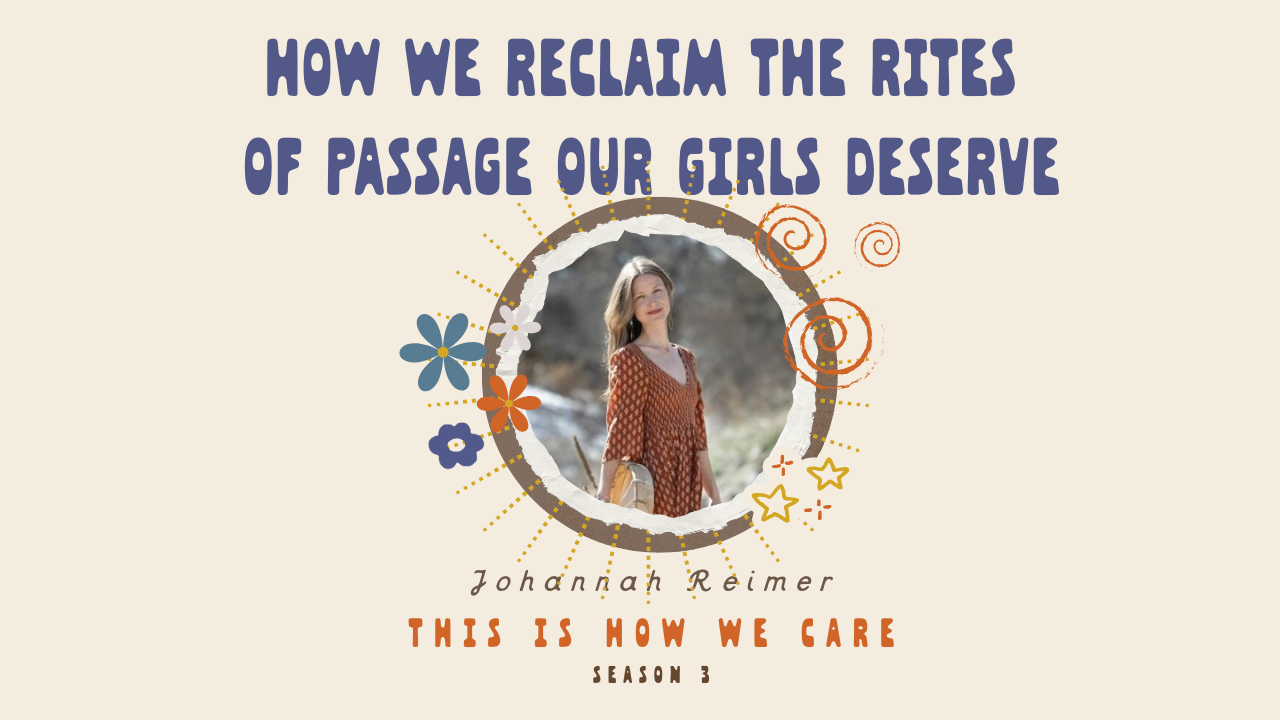
Collage image of Johannah Reimer holding a drum smiling in red dress, collage elements include sunburst, flowers, stars, a red swirl, and the podcast icon for “education” (purple flower). Text reads “HOW WE RECLAIM THE RITES OF PASSAGE OUR GIRLS DESERVE” Johannah Reimer This Is How We Care Season 3
In this conversation with ceremonialist, teen mentor, and soul-centric educator Johannah Reimer we explore how to bring back the village-held rites of passage that our girls—and all young people—deserve.
Johannah and Emily dive into the developmental arc from childhood to adolescence, the spiritual and biological transitions young girls move through, and the deep cultural poverty created by the loss of elders, ceremony, and shared responsibility. Together, they illuminate a path toward reclaiming ancestral wisdom, building ritual in everyday life, supporting girls through their first blood with reverence, and cultivating the council, community, and belonging every young person is wired for.
This episode covers:
What rites of passage actually are (and why they matter more than ever)
How girls experience the shift into maidenhood—and what support they truly need
The three stages of an initiation + where modern culture gets stuck
Why adolescence is spiritually and psychologically tender, and why peers alone cannot guide each other
How council practice builds emotional resilience, listening skills, and community-mindedness
The danger of raising adults who never move past the adolescent ego
How to reconnect with your own ancestry to craft culturally-rooted ritual without appropriation
Simple ways aunties, uncles, elders, and childfree adults can step into village roles
A practical “next step” anyone can take to begin weaving a more connected culture for youth
To Connect with Johannah:
Website: https://wakefulnature.com
Rekindling the Hearth Series (Seasonal Family Rituals): https://wakefulnature.com/rekindle
Girls’ Rites of Passage Mentorship & Facilitator Training: https://wakefulnature.com/training
To Work with Emily — the Revillaging Mama:
The Third Space – A community of revillagers bringing the village to life through practice, prayer and play
Revillage Your Life – A 4-month mentorship container to transform your experience from “isolated” to “supported”
BOOK A FREE DISCOVERY CALL to explore the next layer of support for your revillaging journey
Transcript
Emily Race-Newmark:
Welcome to This Is How We Care, a podcast that imagines what kind of world our children want to inherit and how we, the village raising them, can embody that world. I’m your host, Emily Race-Newmark.
Thank you for being here. I am like a little crusty still from sleep because my 18 month old decided to party from around 3 a.m. to 5 a.m. and it was one of those moments — for parents of young children or those with older children, if you can remember what this feels like — it’s just one of those moments, right? Where I had to surrender and be like, this is what’s happening and it’s okay. I will make up for the lost sleep at some point. And I honestly just was having fun with her giggling as I was like hiding her under the blankets.
But why am I sharing about the throes of early childhood? Well, because in this episode that you’re about to listen to, we’re talking about very directly what it means to care for the future generation.
Our guest today, Johannah Reimer, is someone who spent a lot of her life working with youth in all different stages of life. She’s also a mother herself. And so in this episode, we talk a bit about the developmental arc and how we can show up for children, but specifically her work in supporting young girls as they step into that threshold of young womanhood is so exciting to me.
I actually met Johannah in a very kind of kismet way; I was at a birthday party for someone who’s very dear in our hearts and is part of my village here. And I was talking to Johannah — she was a new face— and I was sharing with her a bit about my work and revillaging and supporting parents and bringing the village they were meant to inherit back to life. And she was like, I totally get it. I refer to it as that, too.
She shared a bit about her work in supporting young girls in stepping through this threshold, this initiatory process of becoming young woman. And I was so enthralled by this. I was like, yes, this is such an important piece of re-villaging, of bringing the village back to life is how do we support what it means to become an adult, what it means to kind of slowly leave childhood behind. How do we support that?
And for those of you listening, mean, think about it. What was your experience of stepping into young adulthood? What was it like for you, if you’re a woman, to experience your first bleed?
We get into this in our episode with Johannah, but to create the world of who Johannah is for a moment, she refers to herself as a soul-centric educator, which is definitely something we need in these times. She’s a ceremonialist, a teen mentor, and an artist of many traits. She’s also a mother to her son, Haven, and she’s trained as a Waldorf teacher.
As she speaks to in this episode, she’s been working with children for over 20 years and really, and a lot of her lens comes from that lived experience of seeing what is missing in our education and how she could start to fill the gap.
One thing about Johannah that I really admire is that she really honors and points to her elders, those that have come before her that have shown her the way. And some of those include Sage Hamilton and Melissa Michaels of SOMA Source.
Johannah has worked under the guidance of her elder Sage as a Waldorf teacher for many years. If you’re not familiar with the Waldorf philosophy, Johannah will share a bit about that here.
She also has been an embodied leader for the international youth movement based in Rites of Passage with Golden Bridge and Golden Girls Global.
You’re gonna hear from Johannah in a moment, but one thing I wanted to plug before we get into this episode is that she has an upcoming workshop coming up — if you’re listening to this in early December, you might wanna sign up for her Rekindling the Hearth series.
This is such a beautiful series that’s about exploring seasonal and ancestral ways of deepening our family lives. I know that that is something I am definitely on a path of rekindling — hence the title. The next workshop on December 11th is focused on the winter solstice and the roots of Christmas. If that speaks to you, you might want to go ahead and sign up for that now. It’s in the show notes of this episode.
Alright, I’m so excited to share this episode with you. Let us know what you think, and share this episode if it really speaks to you so that this vision of possibility doesn’t just live with a few of us, but with many. Enjoy.
Emily Race-Newmark (04:09)
Welcome Johannah. Thank you so much for being together in this conversation. I know we just took a grounding moment together and I’m really feeling excited for what emerges in our conversation today.
Johannah Reimer (04:20)
Me too, thanks for having me.
Emily Race-Newmark (04:21)
If you don’t mind sharing a story of how you got into leadership that you’re holding, how did this all come to be?
Johannah Reimer (04:28)
Hmm, yeah, you know, education has just always been a calling for me, not necessarily one that I chose, but it chose me. I’ve really felt claimed by the future generations throughout my life, starting from when I was 18 and became a preschool teacher. And over the years of like my 20s traveling and living in different parts of the world, I just always found myself in schools.
So I found my way just being in relationship with the youth in creative ways. And having traveled the world ⁓ throughout my 20s and parts of my 30s, just you see the struggle that is going on from colonialism, capitalism, and how it affects different regions, environmental catastrophes. And I just wanted to do something in my young idealistic self. “I want to save the world. I want to create peace.” And it just felt like education is the way — that education and also the way we raise our children.
But for me being a childless person at the time, education was the path to really creating new pathways to a different culture of building more relationship with the earth, building more relationship with spirit.
I was on this mission, by the time I was in my late twenties, to find what was the most holistic model of education. Having explored so many different modalities, what I landed on was really like Spirit whispering in someone’s ear and telling me that I was a Waldorf teacher and didn’t even know it. And something alchemical happened in me in that moment. And the next day I’m looking up a Waldorf teacher training and a week later I’m moving my entire life and body to Oregon to go become a Waldorf teacher quite spontaneously.
I would say all the different work I did with children in different ways it’s been like about 20 years of working with kids, you start to see patterns. And there’s these gaps that are missing even in holistic models of education.
It was these gaps informed by my own rites of passage journey and mentorship and eldership that was guiding me onto a ceremonial path using ritual and rites of passage as a means to both unwind trauma and really tap into destiny…. and I just thought that there are these really big gaps around community and around sexuality and around the village-styled mentorship that just existed that we were all, we’re all wired for.
It’s been way longer that we’ve had Village than we haven’t had that Village companionship, guidance, mentorship, support.
I found my way to meeting these voids that, are so prevalent in our society today through what I felt called to serve, which was our the girls, our future women of the world.
We need to create safe spaces where children can be consciously and lovingly held from this transition that we all go through biologically, which is the transition from childhood into maidenhood adolescence.
It’s a biological rite of passage that every female body goes through. No matter how you identify, we all go through a biological passage by way of puberty. And there’s a real awakening to the bigger world during that time. And what’s going on in our world is crazy. It’s so overwhelming. They need a lot of support. They need way more support than one person, me, holding these spaces.
And so in short, that is how I came to offering my girls groups, which are, rites of passage informed, ongoing mentorship circles for young girls.
Emily Race-Newmark (08:52)
Mm, my gosh. One of the most emotional things as you were sharing — to connect it to my personal life — is I have two daughters, three and one years old. So beginning of their life path. But I often get the thought, even when I’m looking at them or when I’m reflecting on the day, like, oh, these are girls that will become women. And it really shakes me in the sense of ….my experience of myself as a girl versus my experience of myself in the world as a woman is very, very different. All of the things inside of that, good, bad, and indifferent.
One, to acknowledge how important the work you’re doing is and to underline what you said, that it’s not actually just the role of one person. So we’ll get into that.
I would also like to slow it down. For those who are like, rites of passage sounds interesting, but what do we mean; can you define for us, what do you mean by rites of passage?
Johannah Reimer (09:41)
Sure. “Rites of passage” is really a term that was coined by around the turn of the century, a man in Europe who looked at different indigenous cultures and saw that there was a pattern in initiatory rights that cultures used to help mark a transition from one phase of life to another.
There’s different rites of passages now, right? There’s cultural ones and then there’s biological and archetypal ones. And so I see it as there’s traditional rites of passage and modern day rites of passage.
We can kind of unpack that a little bit more, but just to go back to the three stages of a rite of passage is that there’s a clear structure.
The first stage is leaving behind your ordinary life. So it’s severance.
And it’s the separation from an older identity, just like the mundane part of your life that’s just kind of going through, you’re just cycling through life, right? We can’t have a transformational or threshold experience if we’re just doing the same thing day to day to day to day to day. So there’s a severance. That’s that separation phase. A vision quest is a very common right of passage now where traditionally Native American, there’s definitely ⁓ different parts of the world that have used fasting, but you’re leaving behind your life and you’re going up on the mountain, let’s say, right?
And then during that time is the second stage and that’s the threshold stage or the liminality stage.
And that’s really the like, imaginal cell phase of a rite of passage. It’s a time of challenge, transformation and initiation, ideally, right? There’s like a shedding of the old ways and really like an emergence of the new you.
And then the last stage is the return or the integration phase.
And it’s when the initiate comes back. And ideally, if we’ve done the rite of passage well, they come back with a new status, a new role, and they’re welcomed and integrated back into life in a new way. And that is really what our culture struggles the most with, because we love to step away from everyday life. And we love transformational experiences. I mean, they’re sold to us, like they’re marketed and everybody wants to have like, you know, this amazing transformational experience.
But what we don’t often do is the integration. And so how do we actually mark that an adolescent is no longer a child or an adolescent is now an adult, or a mother is not who she used to be since giving birth and going through that initiation?
How do we actually make that an initiation too? Not just, I did this thing and so, you know, I’m different. It’s like, what is really different? And that’s where the guidance and support of community, of elders, of what you and I love to call village. It’s like, that’s actually where we really need witnesses and guides, and that is, you know, so lacking in our times.
And it’s something to really grieve and to really seek out. There are elders out there and my teacher, Steven Jenkinson, he always says that’s like, you make the elder by going to the elder. An elder just by way of age doesn’t mean you’re an elder. We actually need to call forth the elder.
And so really, it’s a plea to all of us to go out, find the elders, make them elders by seeking them out, by asking them questions, by being in their company.
Emily Race-Newmark (13:38)
You’r touching on for me when I look at the village that I’m weaving, where I look at the gaps or the things I desire, the [current] presence of elders is not enough for what I want. So thank you for touching on how it might look to weave that in.
And actually, this is a perfect segue; I want to focus on your vision. If you could speak to, broadly, the type of world you would love our children to inherit.
I know it’s such a big question — but what would that look like and feel like and how would we experience it?
Johannah Reimer (14:08)
Hmm. What a beautiful question and such a mighty one too, you know?
I guess ultimately what I want for my child and what I want for all children is to be in good relationship with life, to honor the life that is all around them, the spirit that moves through all things.
Because I believe when we are tapped into that, when we are truly connected, everything else really sorts itself out.
When we live a prayerful life, when we live in connection to spirit and see that everything is alive and we are all dependent on one another, I think everything else sorts itself out.
Emily Race-Newmark (14:53)
I think like anyone listening to this would probably nod their head in agreement, be like, yes, I would love that too. And then it’s like, well, then what does that look like in our practical day to day, especially given that pull towards the contrast. How do you bring that to life?
Johannah Reimer (15:09)
Yeah, it all begins with how we live our lives, you know, working with children. It’s like, how are we modeling the world that we want to give our children, while a world is falling apart, quite literally. I mean, we are in really, really scary times. And, you know, it only seems to be getting worse.
Joanna Macy talks about the Great Turning. It’s like, we are in that Great Turning right now. And there are different places that everyone is needed in the Great Turning. There are people who need to help deconstruct all of these unhealthy, capitalist, patriarchal structures.
And we also need people holding off all the environmental devastation that’s happening and destruction. And then we need people creating the new, the alternative. I did activism and it burned me out so badly. And so I’ve really put all of my energy into creating a different culture for girls.
And then of course I gave birth to a boy. So now I’m like, okay, we need to not genderize this whole thing. All humans really need more village. We need more community. We need more ritual. We need more ceremony. We need more time outdoors to counter the insanity of technology.
I believe that that is the antidote and schools are, I mean, I live in an alternative tiny little town and the public school of first grade, you get a iPad. With the dawn of AI, it’s like, what, how are we going to counter all of this?
The age of Aquarius is not just peace and love and village. It’s also technology. And so I wonder about what our children are inheriting with the rise of consciousness. I believe consciousness is definitely changing and people are starting to wake up, but there’s also the rise of technology.
It’s constantly an evolving question. There’s always something new emergent in life. And so my work is always changing. And right now it is really centered around bringing ceremony and ritual and authentic expression and deep belonging to girls.
I do that through the girls group by creating safe containers for girls to really bring all parts of themselves. And we use creative expression. We use these like age old technologies of story, of song, art, play, nature connection and primitive skills to really like build relationship to life.
Emily Race-Newmark (18:01)
Yeah, so you’re basically saying it’s through our own being. It’s what we’re practicing. And then there’s almost these different containers to practice it. And it’s everywhere in our lives that we have the opportunity to play with this deep relationality.
So now zooming in on the work that you’re doing with girls and young women; what would be your vision for that as well for, not just what you’re leading, but more broadly as a cultural shift? Like, what would you like to see?
Johannah Reimer (18:27)
Hmm, beautiful question. Yeah, I think that, you know, initiation practices, because they are so rooted in our DNA, that these are traditional ways and something has really gone awry in our time. And we have to look back, I think, to these old practices. And we have to create new ways to bring them because we haven’t been given the map.
You know, I’m assuming you’re also of European descent and there aren’t a lot of maps due to our people being colonized, right, by the Roman Empire; history repeats itself and we have lost — you know, there are breadcrumbs, but we have to pick up those breadcrumbs and we have to craft something new.
And so really that’s my plea and my hope and really the call that I have heard is like crafting something new, unique to the group of girls that are in front of me.
That would be my hope for everyone out there to really listen and attune to what’s happening right now in the group field that they exist in. And how can we support a healthy passage through for those who are at transitional moments in their life.
Emily Race-Newmark (19:47)
One thing I know is you are reframing what menstruation looks like; I think you even talked about not liking the word “period”, but even rebranding, so to speak, how we relate to that.
Can you speak about how your work is holding that part of the transition and what that cultural shift looks like?
Johannah Reimer (20:08)
Yeah, well, I mean, as a grown woman, there’s so many things that I had to unlearn and then also just had to learn because they weren’t provided to me. And I believe it’s our birthright to share this wise woman information that was traditionally passed on in ceremonial and ritual based ways, you know, way back to the Red Tent era.
Every culture had their own version of the Red Tent. Women have always gathered, and we need to keep gathering and to pass on these ways. What’s so common now is women’s groups. Rites of passage and vision quests became popularized many decades ago, I think, in our more modern culture, but there weren’t really initiation rites that became more popularized for women.
It’s like women’s circles. And yes, that’s beautiful, that’s important maintenance, but what about the younger generation? What about all these girls who aren’t getting this information at school?
Most are not even getting it from their families. And so that’s again going back to why I chose education because it’s like we actually have the opportunity by working with the youth to create a future culture that is rooted in whatever the values that you’re imbuing the children with. It’s hard to change people who are in their 50s and 60s and 40s. And so I’m more interested in going to where there’s pliability and they are innately connected. They are innately connected to spirit. They are innately connected to the animate forces all around.
You go out in the woods with a child and you will experience how connected they are. It’s us who pull them out of that, right? Through psychologizing things through asking too many questions and pulling them out of their experience and into their intellect, which we actually don’t need more intellect in these times. We need more soul, more heart, and more earth based connection. The intellect is going to be there.
Emily Race-Newmark (22:21)
Yeah, well, especially with AI; I hear you, right? I think about this too. It’s like, where are we headed and evolving and what are we worshiping in the process? I’m so with you on that path of, what can I embody and model for my children? That it’s a safe place to be is in their sensory.
Talk to us more about in that adolescence phase, maybe even developmentally is there a shift that’s happening with more praise of intellect or what does that look like and how are you holding on to the spiritual, the soul?
Johannah Reimer (22:49)
Yeah. So when adolescence hits, the intellect does come far more on board. The first seven years, the organs are all forming and it’s really about like rhythm for the child as those rhythmic organs are fully forming. And from a spiritual perspective, that Rudolf Steiner, I learned from my Waldorf training, he teaches that as the child’s physical body is forming, they are sharing an etheric body with their mother. And the etheric body is the life force body. And once the milk teeth start to fall out from the child, that means that all those forces that were focusing on the organ development are now free for thinking. And that’s when ideally a child would start their education journey.
And now we’re teaching children by the like two, three, four years old in preschool when all they need to be doing is playing and connecting with the earth. Because you know what, if they have experiences of just being in love with the plants, with the rocks or the river or whatever it is, then one day when their intellect understands what’s actually happening, they will fight for it.
Not because they learned that something was wrong and bad at four years old. We actually need to preserve their awe and wonder. And I’m really fortunate to work with girls whose parents have valued the preservation of children’s awe and wonder because there is a big difference.
What happens when kids have been over intellectualized before their intellect is really ready and have, they cultivate fear of the world. It’s like things are wrong. Things are scary and anxiety by the time of puberty just skyrockets.
And so the next seven year cycle is seven to 14 and that is when like the child’s etheric body is forming the rhythm and really when ⁓ in at least Waldorf education you have the same teacher from first grade through eighth grade those whole seven years and then middle school and puberty come in and they’re coming in earlier and earlier and so there’s like an evolution that is happening.
We’re talking about like things are constantly emerging, things always need to adapt but really it’s like around 14 that the astral body comes in and the astral body is the soul life. It’s like strong feelings, know, likes and dislikes, sympathies and antipathies and they have like really black and white thinking can come in. And it’s why we need to be just loving support for them.
One of my teachers says, you know, we need an iron fist to work with adolescents and a velvet glove because they really still need so much holding.
Johannah Reimer:
And the way we’re raising adolescents now is that they’re so hard to deal with, that black and white, extremist thinking, the strong feelings. So much drama comes with this stage too. And it’s because they’re seeking actually something bigger.
They want to know that they’re here for a purpose. They want to feel in to liminal experiences. That’s what the astral body is really looking for.
And so it’s a time of initiation and they will self-initiate if we are not offering them safe, contained spaces for them to experience these things.
Emily Race-Newmark (26:30)
Great.
I don’t know if you heard of the book Hold On to Your Kids about peer orientation. Gordon Neufeld and Gabor Mate co-wrote it. But basically, what they speak of is, in the absence of the attachment village, we start to see peers attaching to one another and guiding one another through these moments. So I’m imagining now in adolescence a bunch of lost adolescents trying to find their way unless there’s a container to hold them and say, here’s how you can make sense of this moment.
Could you almost bring us into the room with you all? What are some of the stories or the challenges that arise, and how are you meeting that moment?
Johannah Reimer (27:17)
Yeah, I love to start working with the girls right before puberty hits. It’s kind of this golden time where we build safety and trust through play and through experiencing the journey through the elements curriculum that I’ve created.
And it’s really about connecting with earth, connecting with water, fire and air in a really intimate way that helps us understand ourself and helps us understand the world and the animate forces at play because you know what? There is not one child I’ve ever met that does not think the earth is alive. There is not one child that thinks that the river does not sing or is also alive. They know!
But we aren’t living in ways that are honoring the spirit, the goddess, the life force of each element. And so the curriculum really is about supporting them remembering and like building capacity for ceremony, for ritual, and really for counsel. speaking from the heart and listening from the heart.
I remember when I first started working with the girls, thought, ⁓ gosh, I wonder if I’m creating more self-indulgent people talking about themselves and being self-absorbed. And I brought it to the parent body because I also work with the parents. It’s about building a culture that is raising our children in a different way that’s supportive of one another. And we’ve done counsel with the parents and the children. We’ve done, passages that are marking the changes that these girls are doing with their families and ideally with the greater community as well.
But I just remember a mom saying, no, you are not creating more selfish [children] they are one part self-centered maybe by their sharing and then 10 parts listening. And I realized, yeah, it’s also a part of building the capacity to truly listen.
Imagine if our leaders had learned the art of council at 10 years old. You know, these girls have things to share. And when you create the space, things start to arise and every single group is different. There’s a different group soul that emerges.
And so there is this archetypal blueprint of the elements that I use. And it culminates in their rite of passage from childhood into maidenhood. And as I see it, it’s like just because they start bleeding, just because their breasts are budding and they go through this challenge that I have for them, it doesn’t mean that they’re suddenly women.
I think that when I was a young girl and I started my moon time, my mother, all she said to me was, congratulations, now you’re a woman. And I was so confused by that. You know, I didn’t have any like context or way to make sense of that. I didn’t have anyone to tell me what was really going on and help me navigate the confusion. And so it’s like all these missing pieces that I had in my own life, that I’ve seen throughout the world, that I’m trying to fill in an offer to these children.
And we need it all across the board. It’s not just girls. We need it for queer and trans. We need it for boys. We need to start focusing more on the youth because there’s so much time and energy and resources that are going into healing different developmental stages that didn’t get met well for all of us. And that will probably still happen, you know, it’s part of the human life is like going through trauma and finding our sacred wounds.
But I believe that we can be doing it and setting them up very differently so that their time and energy and resources can be going towards life-giving, regenerative, sustainable ways that we can live in more harmony and connection with each other and with the earth.
Emily Race-Newmark (31:30)
That was so profound, the elemental introduction and the way you’re weaving that in. It’s about the relationship once again, and the context from which we’re relating to these pieces of animate life.
Another component is the counsel that you’re speaking of. I had recently been thinking like, counsel, counsel, like it’s an energy that I’m feeling that’s lacking, that I’m craving. I would love for you to describe that more. Is it just sitting in a circle and everyone’s sharing? Or like, is really the essence of what’s happening there?
Johannah Reimer (32:05)
Yeah, well there’s a great book, The Way of Council, and that is a great starting place for anyone interested in the art of council. There’s many different ways, and the way that I have found works best with the girls is to really set the stage and share the rules of council.
They start off with speaking from the heart, listening from the heart. No crosstalk, like no interrupting, which is really a new pattern for young girls, especially adolescents who love to blurt out and so ask for some restrainment. And then being lean on words. And that’s not really a rule that I emphasize much with girls because just getting them comfortable with sharing can sometimes take years.
Some girls are instantly vulnerable and really have the capacity there. And then some of us, I know for myself, being vulnerable is hard. And so over time that happens. But just the role of being there listening from your heart and speaking from your heart, that alone creates a completely different energetic field. And we just go around the circle. Sometimes I give prompts based on whatever themes we’re working with.
And the older ones really, they come in after a couple of years of doing council with me and they just beg for it. They’re like, can we please do council? Can we please do council?
We need to do it at council. And see how hungry they are for something deeper than the surface.
I can only speak from my own experience of witnessing what they have shared in some instances, even deeper than some women that I’ve sat in this council with. It’s really profound. Why aren’t we creating these spaces more readily for all of us? And maybe it’s just that some of us haven’t had the experience. And my prayer is that all your listeners and everyone everywhere gets to have these opportunities and these experiences.
That’s why our education system is so important. There’s so much red tape, so much bureaucracy. I really thought I would be working in the public school system trying to bring some of these ways and it just wore me down. And so, you know, I’ve found my circuitous way to bringing it.
And yeah, I think that there’s just… there are so many misses happening because we’re all burnt out and we’re all overwhelmed. And there’s so much being asked of us and stretching us in ways that consume us and not necessarily the ways we want to be giving to our life and to our world. And so how do each of us for our own selves really like carve out the time to take care of ourselves.
And taking care of ourselves in community. We’ve hyper individualized our entire world. Everything is about ourselves and what we need. And I see that in modern day rites of passage even where it’s like it’s become very individualized rather than about the greater community.
It used to be for the whole village that we initiated our youth, right? Because we passed on our values, our own cosmology, our ways with the next generation through initiation.
Emily Race-Newmark (35:52)
Yeah, well, I’m glad you’re saying that because one thing I’m actively reimagining is that the role of raising children is not just this nuclear family, but rather the role of many aunties and uncles and grandparents and all these generations. And I also feel in that there’s a call and a prayer to those who don’t have children that they birth themselves to say, are needed here. It’s not this delineation of either you have kids or you don’t.
So, you know, whether it’s in the rite of passage of, of adolescence to adulthood or whatever piece of this, like, is your vision for the aunties and the uncles? How would you like to see these other adult figures play a role?
Johannah Reimer (36:27)
I think it’s the same way as I spoke to about elderhood. Go extend yourself and make yourself a village uncle, a village auntie by extending yourselves, getting curious. I have a niece and a nephew and there’s certain ways I extend myself to them. But what about all of the other youth that are actually far more in my life, because my sister lives in New York City, right? So I actually don’t see my niece and nephew very often. we just go through our life with blinders on so often. And so how do we actually take those blinders off and see what’s right in front of us?
And if there is a child, there is for sure a need there. We don’t ideally wait until there’s a crisis. We want to be preventative. And that is really what my work is about is preventative work. How do we support them along the way, knowing what they need and how can we, you know, offer that in whatever way you have capacity for?
It can feel like burden at times to extend ourselves more. Being village-minded is simply extending yourself in the ways that you can. Stretching yourself maybe a little, extending yourself because you know what you might actually get filled up by that service, by that care. Because actually it’s reciprocal. When we give in that way we will receive it and only mystery will know how we will end up receiving it.
Emily Race-Newmark (38:08)
You know, the blinders piece, one of the ways that I noticed this for myself is just simply at the playground with my kids and there’s another set of kids playing there and there. My initial experience was ⁓ everyone’s in a bubble and I’m not going to disturb them. I’m not going to be this creepy woman, but I’m like, but why, where is the creep factor coming from? I’m good hearted. I’m a mother. I’m, I am coming from care.
And I’m not going to force a connection on a child that’s not open to that. But why am I not coming from a place of, like, this is my child also. I care for this child also. So I do think there’s a mindset piece. And I love that invitation to just play with the extension. See where you could stretch in ways that also may feel good.
Johannah Reimer(38:52)
Yeah, that can also trigger other parents, you know, like there is such a divide. And what I see is the reason for that is that we have not matured past adolescence. And this is also why we deeply need rites of passage work. We need actual threshold experiences that help mark us from one stage of life to another where we actually are passing through a different stage because we live in an egocentric world.
It’s all about us. And so I really believe that initiation is the way to expanding ourselves into a more than human and more than self-orientation, which Bill Plotkin would call ecocentric, right? We want to move from an egocentric culture to an eco.
We are also rubbing up against so many adolescent identities out in the world, no matter what the age is, whether they’re an adult, whether they’re grandparents, they might still be acting from the seat of a 16 year old.
Emily Race-Newmark (39:49)
Wow.
Wow, wow, wow. Meaning like there hasn’t been, because there’s no initiation there, there hasn’t been an orientation towards the collective and to how I am a part of a greater whole. And so there’s, that defensiveness is coming from an ego-driven place is basically what you’re saying.
Johannah Reimer(40:08)
Mm-hmm.
Absolutely. That we have a hard time orienting towards anything other than ourself because adolescence is naturally a self-centered time. You are literally creating your first ego.
And part of right of passage is letting that ego die so a new one can be formed. Carl Jung speaks to two egos that are formed. And it’s like the first one is formed during adolescence. And if we don’t have culturally intact value-based rites of passage that initiate the adolescent into true adulthood, that second ego isn’t going to get formed. And that is what we’re contending with in our world.
Look at our leaders. Look at the leaders throughout the world.
Emily Race-Newmark (40:57)
Hmm, frozen in adolescence.
Johannah Reimer (40:59)
Yeah, and you know, I do, to speak to the training, I offer a girls group facilitator training for women that are interested in this call to being more of a village auntie and holding girls in this really sacred ancestral way. And I asked them in the application, did you have a rite of passage at any point in your life? Like, was your moon time honored?
Out of a hundred applicants, I have had one person say yes. And that really speaks to the poverty of our times and what we are working with and how needed. If this is part of our ancestral blueprint, part of the ways our ancestors like actually passed on culture and values and purpose, we’re really missing the boat. And it’s really time for us to wake up and start to really normalize them.
That is the other thing that I’m coming up against with is that because the girls are not watching other girls — or their mothers never went through a rite of passage, it’s a little weird. And it’s also a little bit of a hard sell. Like, hey, do you want to go have a really big challenge? And maybe you won’t get through it on the other side, you know? Because ideally they won’t. A new part of themselves will come forward.
So it’s tricky. It’s really tricky. And what I’m seeing in terms of ceremony is that girls are being celebrated now, for getting their moon cycle, but there isn’t actually a ceremony and a marking of, okay, you’re different now. And what’s your role? How am going to treat you differently?
Emily Race-Newmark (42:25)
So I think what you’re touching on is really critical, too, for listeners who are leaning into this conversation. They’re like, I love this vision. I love that you’re doing this, but I haven’t experienced this myself. I don’t have the embodied experience of what this means or feels like.
So how do we hold space for something we haven’t received ourselves? What’s the invitation there where you would guide someone to start?
Johannah Reimer (43:10)
Yeah, that is the conundrum that I have really had to contend with. And I remember holding my first moon ceremony for my first round of girls that I stayed with from fifth grade through senior year. And the girl who started her period first, she really wanted to have, you know, a ceremony. And I did it as best as I could.
And afterwards, I swear I would never do another one. Because I felt like such an imposter. I felt like I didn’t have this. I have no idea why I think I’m the one to hold this. And I didn’t do one for years, I think for two or three years.
And then I got asked again and I thought, well, I can either do my best to listen and trust in spirit and really craft something beautiful without stealing from another culture. Or this girl can get nothing.
And so we do our best and there are people out there that are offering these experiences of like, get the rite of passage that you never got.
Go find the Animas Valley Institute or School of Lost Borders or Tree of Life initiations. They’re giving them retrospective, like first moon so that we can then offer it to the girls.
And then there’s, you know, my training offers an initiatory path for you to heal a lot of those adolescent wounds that didn’t get met, and I don’t know anyone who went through adolescence without some wounding, right? It’s just a tricky, tricky time.
Emily Race-Newmark (44:51)
Yeah, I really resonate with that experience of like the imposter because there haven’t been many models. And also because of colonization and the severance as a European descendant from my own culture inheritance, just like, well, how do I do this without appropriating a different culture?
Maybe you have thoughts on that because I know that’s something that is part of your path as well. How do you do that? Is it just simply listening or how do you hold yourself accountable?
Johannah Reimer (45:19)
Well, it’s listening and doing work, like looking back, actually figuring out who your people were, what they were going through, what did they make as offerings, who were their ancestors in the more than human world. That is part of the first module in my training of like ancestral maps, like there actually is enough even though we don’t have like the initiatory maps or I have not found them.
I think that we can look back enough and understand what happened, why we don’t have the maps and to really look at like, okay, what are some of the like textiles that my ancestors used?
What are some of the ways my ancestors used their hands? What are the songs of my people? What are the stories?
And we are lucky that actually as European descendant people, there are a lot of fairy tales. There are a lot of stories and there are blueprints to both initiation and being a good human being of going on a journey and finding your destiny. Like that is actually still there. And so we can use the stories, the songs, the crafts as breadcrumbs and weave those into our work, into our life ways, and into the ways that we’re raising our children.
Emily Race-Newmark (46:47)
Yeah, thank you for that. I found that ⁓ the breadcrumbs is like such a piece for me as I try to reconnect with my ancestry. I just was doing like a bead weaving workshop and learned that my grandmother’s Czech and that like the beads and Czech are like very interwoven. I’m like, follow this path. Like, let’s see what happens. Yeah.
Johannah Reimer (47:03)
Yeah, and the symbols all meant different things and the colors meant different things and such a rich journey. Yeah, the craft.
Emily Race-Newmark (47:07)
Yeah, but it begins with a prayer, right? Because I said that prayer, I think, now, two or three years ago. And it takes time. And I think that’s something, too, in this paradigm that you’re speaking of that we’re weaving here. There is a factor of everything is not going to necessarily happen overnight.
I don’t know if you want to speak to the urgency culture versus how long is this journey that we’re on.
Johannah Reimer (47:29)
Man, I feel the urgency, you know? It’s hard. It is really hard.
Really to go fast, we’ve got to go slow. It’s like the slowing down is the way that we actually tap into connection.
And I am working so hard on just slowing down and not being a perfectionist because my ancestors were Puritans. And you know, there was a perfectionism and an urgency, I think from like fleeing their lands and that, you know, lives in my bones, lives in my soul. I can feel the urgency so deeply.
So, yeah, it’s like prayer for sure, but that’s also not enough. We also have to be, stepping into the world in a prayerful way. So may your prayer be in action with grace and in connection to your feet on the earth, right?
Emily Race-Newmark (48:22)
Right. Yeah, there was a guest from the first season I did talked about prayerful action. I just love the weaving of those two kind of energies.
OK, so on that note, I love to always leave our conversations with a prayerful action that someone listening could take. Maybe you, dear listener, have heard many things that you want to dig into or Google or follow up on your practice. But for you to just share with us, Johannah, like what is the invitation if someone was to just try one thing. What would be that invitation?
Johannah Reimer (49:01)
Hmm. Well, I would say start off with finding out who your people are, where they came from. And by figuring out where they came from, those regions, you can look into the animals that lived there or the plants that lived there. And based on those, I think that you can start to tap into a cellular memory and a way of both slowing down and being in that prayerful action for more connection.
Because I believe our ancestors are on the other side, really on our team. And they’re so hungry for us to like find our way, you know, and we all are indigenous. We all were indigenous to a place. And even if you’re an orphan now and you’re on Turtle Island or wherever you find yourself, we did come from a place and we can go back to that place not necessarily physically, that’d be great, but by learning about the plants and the ways, the crafts.
That has been one of the most fulfilling things for me. And for me to be able to share that with the girls and share, like, not because, you know, some other culture that I think is cool did something, but because my people did this.
And there’s just a meaning that is imbued in every aspect of that that reconnects us to body, mind, heart and soul of the universe. I’ve seen that be really inspiring to the youth.
And so many of us, you know, are confused by the times and confused by what’s going on, especially the youth who are being born into these end times. And so to offer, spaces of sanity, sanctuary, that have meaning, something way more meaningful than just our one individual life, you know, is a great starting place.
I believe ancestral reconnection is a great place to do that. And then offer that, to your community, like come learn how to make cordage at my home or “Let’s all make a tincture together and drink herbal tea that our ancestors drank.”
It can be so simple.
Emily Race-Newmark (51:23)
Yeah, I’m really getting that from that too, the adolescent not knowing who I am and wanting to grasp onto some sort of identity outside of myself, like really in that invitation and what you’re modeling is: look within and look back to see like who you are, what legacy you’re carrying. I feel like that would like infuse such a deeper sense of self-confidence than anything else, for us as adults as well.
Johannah Reimer (51:46)
Yeah, and for the youth just to know that they’re needed and they belong is so important in these times because they don’t necessarily know that. We shouldn’t just assume that they know that they’re here for a greater purpose. We have to help one another remember these things.
Emily Race-Newmark (51:58)
Right.
Mm, beautiful. Thank you. We’ll link in the show notes all of the latest ways that people can connect with you. But if there’s anything else you just want to speak to in terms of how can we support you in this work that you’re doing, please let us know.
Johannah Reimer (52:19)
Thank you so much. Yeah, you can just check out my work wakefulnature.com and Yeah, there’s lots of ways to connect.
Emily Race-Newmark (52:21)
Yeah. Beautiful.
Thank you so much, Johannah. I am very filled by this conversation and grateful that we are in geographic proximity so that I can continue to learn from your wisdom.
Johannah Reimer (52:37)
Yeah, thank you.
Emily Race-Newmark (52:41)
Thank you so much for listening. That episode really warmed my heart and has me thinking so much about the ways that I can weave this village auntie identity into my own revillaging experience.
If you are someone who, when listening to this episode, have been sitting with “who am I for my village” and “what am I calling in in terms of relationship with elders or with youth” or “how am I weaving in relationship with nature?” If those are some of the questions you’re sitting with, I want to quickly highlight that I hold several containers to support you on your own re-villaging path, which really begins with connecting with your own inner villager, who you are as the villager, what feels authentic to you, and what does your contribution to the village look like? What are you building? What are you creating? What kind of village are you helping to birth into
If you’re curious to explore what it would look like to receive support on your re-villaging journey, in a container of deep reflection, of accountability, and truly love, then I would love to talk to you. We could have a free discovery call to hear more about where you are in your journey to find the right container that meets you where you are right now.
You can find links book that discovery call with me over at the show notes or to connect with Johannah further she’s always birthing new offerings, including some of the ones that she mentioned here today.
Hope to see you over at thisishowwecare.substack.com for links, transcript for this episode and share this with episode with others.
Thanks for listening.