
A World Our Children Want To Inherit
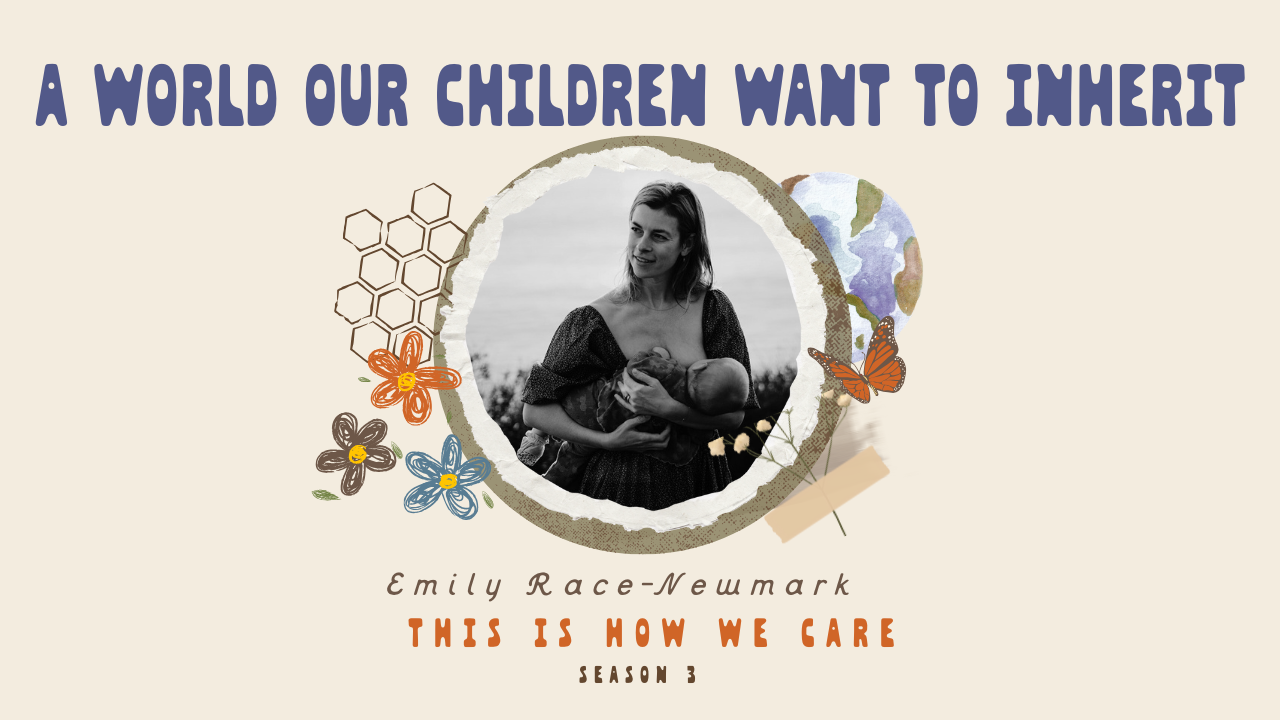
Collage image of Emily Race-Newmark nursing a baby smiling looking off at distance. Collage elements include flowers, honeycomb, a globe, butterfly, composed in a circle surrounding the photo of Emily. Text reads “A WORLD OUR CHILDREN WANT TO INHERIT” Season 3 This is How We Care Emily Race-Newmark
In the Season 3 opener of 'This Is How We Care', host Emily Race-Newmark reflects on the uncertainty of this time in history and the importance of community, especially in parenting. She shares about her personal journey of "revillaging" — of bringing the village paradigm back to life — and how the previous seasons of this how highlights this importance in addressing the multi-crises of our times. Emily emphasizes the significance of understanding what future generations need from us and invites listeners to engage in this transformative journey together.
TO STAY CONNECTED:
Check out www.revillagingmama.com
Subscribe to the newsletter to stay in the loop with latest offerings
Read more about my revillaging reflections on my Substack, Emily Cares
Full transcript for this episode here
Video version of this episode is over at YouTube
Follow @ThisIsHowWeCare and @RevillagingMama on Instagram
Join The Third Space! An online community for revillagers who are putting to practice what we learn on this show, together
Transcript
Emily Race-Newmark:
Welcome to This Is How We Care, a podcast that explores what kind of world our children want to inherit and how we, the village raising them, can embody that world. I’m your host, Emily Race-Newmark.
Emily Race-Newmark:
Hello everybody. Welcome back to a third season of This Is How We Care. Just coming to you after a delicious homemade Sunday dinner. My husband’s walking with the kids around the neighborhood.
Before we dive in to what’s an introductory episode for this season, I’d love to just take a deep breath together.
Inhaling and exhaling.
Because what a time we are in. There is so much around us that is crumbling. There is so much uncertainty. I feel it. I see others in my life feeling it. I see it on the internet. We are feeling it. I actually didn’t know if I would come back for a third season of this podcast —I’ll share more about that in a moment, but — I realized that these conversations are so critical at this time because we are being inundated with what’s dying, what’s ending, and to root ourselves in possibility for what can be born, to ground ourselves in some sense of togetherness feels critical.
I have gotten so much personally from hosting this podcast, from interviewing the visionaries that have joined us— I can share with you shortly how these first two seasons completely altered my life — but I figured, if I felt this level of impact in such a positive way, there’s reason to keep going. There’s reason to keep recording, to keep sharing these visions for the world. To unite us listeners into some possibility of where to focus our energy, our time, our valuable resources.
OK. So I’m coming back, Season Three, as a new woman, because not only am I now a mother of two children ~ with my husband Charlie taking care of these two young ones has been quite the ride.
For that reason, I should first name, I took a pause from the podcast because I was really tapped out at my maximum.
The podcast itself was such a nourishing outlet for me for a really long time until it no longer became that way. It was actually a place that I was pouring so much of myself into, pouring a lot of time, energy and money into producing. And it started to no longer feel as reciprocal as I needed it to feel, especially in the early throws of postpartum with baby number two.
I also felt like there had been so many insightful conversations — I mean, really amazing guests joined us on the show. And I needed a moment to integrate, right? Like that breath, I needed a moment to inhale and exhale and just see how all this information would be landing in my body and not just staying floating in my head. So we took a pause after recording season two.
I focused on my family and I focused on integrating these conversations. One thing that emerged in that time was really this reflection that across all of the conversations from those first two seasons, when I asked people, “What’s your vision for the world?”, they would either directly or indirectly point to the need for community.
Concurrently, as I stepped into motherhood for the second time, my husband and I trying to find our footing, we were really seeing that the lack of the village, the lack of community in our current social system and structures and institutions and cultural norms was deeply affecting us. It was affecting us mentally and our health, affecting us in our relationship and our ability to have and take time to connect with one another and be able to parent from this place of, “OK, we’re good. We are resourced.” And so we’re kind of like trying to plug holes in a boat while water keeps floating in.
I have to say, I still was someone, I believe who was entering motherhood a second time with some awareness of the need of a village. I felt like we put a lot of effort and energy into trying to build that “basket” to hold us.
And yet, after the six-week mark postpartum, all of that kind of disappears; the family leaves, the doulas leave, the midwives stop checking in. If you’re lucky enough to create the support, there’s all this support… and then there’s no support.
In my own life, I’m experiencing the lack of village. I’m seeing how that’s affecting us and our parenting as individuals, as a couple, as a family with our kids. And I’m seeing this echoed in pretty much every single parent I know; their experience of parenting either being nourished by the village or completely depleted, you know, to alarming, red-flag-SOS-levels when they don’t have the village.
And then I’m integrating these first two seasons, recognizing, “Wow, community is also the solution to so many of the crises that we’re facing right at this time on our planet.”
If we’re looking at an environment, if we’re looking at education, health, if we’re looking at our economic structures, our relationships, all of these things benefit from reweaving community and village back into our lives.
So I decided, what can I do with my very limited resources of time, energy, and money? And I say limited because they are finite to some extent, especially at this stage of my life.
I wanted to make sure that I was investing them in something that would go the distance. I realized that the best place to invest my resources, whatever I have in overflow, is in community building, is in creating village, and in also applying my skill sets — which are in coaching, facilitation, identifying a vision and connecting dots, connecting people, building systems and structures. Those are many of my skill sets from previous lives as well.
I realized, “Oh, I could also be of service in supporting other people in weaving village in their lives.”
For a while, my focus was on the parents. How can other parents start to re-village? How can we do that at the capacity that we have? But also, with time, I started to recognize, we can’t only be talking to parents when we’re talking about village weaving.
We’re really talking to any person who recognizes the need for a community, for intergenerational community, who recognizes themselves to be a caregiver who wants to give to their community, give to others.
And really, I’m talking to people who give a shit about the next generation of human beings. And with that, the next generation of our planet, right? Without the entire ecosystem that we are a part of, not just from a human lens, but a more-than-human lens, the entirety of the whole ecosystem.
That brings me to two things. I have re-emerged in the world as the “Revillaging Mama”. That’s how you can find me on Instagram, on Substack. That’s how I’m presenting myself as a coach, as a facilitator, as a mentor, as a support.
It’s interesting to claim that as an identity, right? Because with that comes a lot of “imposter", like, “can I claim this revillaging mama identity?”
Well, I’m here to tell you this: revillaging is a path. It’s literally a commitment, I see it, for the rest of your life. There is no end game with revillaging. It’s a practice of weaving community, and a village mindset, back into our day-to-day reality.
So in that, I have my learnings. I have the things I’m trying. I have what I’m observing and want to share, and in that I’m also having the things that I’m still struggling with.
I, as I have always been on this podcast, aim to be as transparent as possible, as human as possible in that experience, because I believe that that’s another way to be of service.
And then when it comes to this podcast, I was sitting with, once I had this clarity — “revillaging mama”, “revillaging as a path”, “revillaging as a way to support other families”, I was developing my offerings, working with some one-on-one clients, starting to work, exploring what it looks like to work with groups — I realized, the podcast actually really serves this work as well. It’s reciprocal.
It works together because on one hand, the podcast is what inspired me to follow this revillaging path. And I believe anyone else who feels called to look at revillaging, to weave community back into their life, can really be nourished by these visions, these stories of possibility that we have on this podcast.
With that clarity, I decided to come back to here, to the screen, to the mic, to sit with you all and interview guests for a third season. And the guests are showing up. They’re flying in with “yes”es. People are ready to record.
As I record this, I’ve only recorded a couple episodes. This is where I’m shifting things for the third season in order for this to be sustainable.
I am releasing perfection. I’m releasing too much structure. This is something I’m recognizing in my life in general. Sometimes structure is super helpful, but sometimes structure can actually suck the life out of something and not let relationship thrive, right? Not let something breathe and grow organically.
I actually learned that from David Jay, who’s one of the guests we’re going to have on this season of This Is How We Care. I’m so, so excited to share with you some of the conversations that are going to be coming through.
But in that, the podcast itself is going to take a new flow, a new format, and we’ll see how it goes. I am experimenting with video content instead of just audio because, for one, from a relational lens, how does that lend itself to building more trust? I’m a real person. These are real people. Being together [over video], even though not in real life, this is another dimension of being together.
And I am letting go of this like rigid structure of, “I have to record all these episodes and they’re going to get released once a week and blah, blah, blah”. Part of the feedback I received after the second season was that the cadence of weekly releasing was actually not serving my community. You, the listeners, you were feeling like, “whoa, I have to catch up on all these episodes. I’m behind.” And that actually was a reason to disengage.
I don’t want to add more stress to your plate. I know I can’t keep up with a weekly podcast as a listener, and truthfully as a producer and as a host creating this, it was feeling like a lot. I would much rather let the content come through and release it when it’s ready, but not follow some rigid structure or schedule. So, we’ll see how that all goes.
And then again, the third piece is I really, really, really want to hear from you all. So please, don’t just remain this anonymous listener that I don’t know anything about you, or what you care about, or what you want to learn about.
There are so many ways we can stay connected. I’m finding that Instagram, as much as I have a love-hate relationship with it, can be one of those places for connection. So if you follow me @revillagingmama or if you follow us @thisishowwecare, please comment, like, share, engage with the content, let us know you’re listening, that you’re enjoying it. Give us feedback on things you’re wrestling with or questions that you have, what you want to learn more about.
We can chat in the DMs. We can exchange email addresses there. (Or the comments of this Substack post!)
I like to direct people to Instagram (or Substack) because it’s usually an easy way to find everything in one place and start to get more of this revillaging conversation and these conversations from the podcast in your feed.
Because our feed, if we’re on social media, is feeding our mindset. It’s feeding our perception of the world. And so my hope, my desire is that this content will start feeding possibility, not just anxiety and worry and separation and doom and disassociation.
I’m really hoping that this is a place to come to, to bring you back to your body, to bring you back to your heart, to bring you back to what you care about, and for us to collectively come together in a vision for what kind of world do our children, our collective children, want to inherit. And that’s what we’re here to uncover in this season.
We’re here to discover, “what is the kind of world that our children want to inherit? What are they looking for?”
And at this dawn of so much new disruption and the newness of AI, and so much that is dissolving and so much feels unprecedented, where do we focus our energy?
Especially when we look at the new generations that are coming through. What do they need from us? Who do we need to be? What do we need to practice? What do we need to learn?
Join me on this season, season three of This Is How We Care. I really look forward to getting back here, interviewing these guests. And again, I hope to hear from you.
If you’re not on Instagram, you can also just head over to my website. It’s www.emilyrace.com. You can also head over to thisishowwecare.com. You should be able to find ways to stay in touch there. Shoot me an email. That’s a great way to just get in contact with whatever matters most to you, because I will respond and I will connect you with what you need, what you’re looking for.
I’m a curious person. I love to hear from you and ask you some questions to see how I could best be of service.
And of course, if you feel a true connection to this work of revillaging — revillaging as a spiritual, creative, and relational path — if you feel inspired by these conversations and want to start applying them in your life within a container, whether that’s group or one-on-one, I would love to support you in that.
I truly would love to open up space to hold you in that, to walk alongside you in that, to reflect questions back to you, and to really hold you in that transformative journey of becoming the inner villager, applying what speaks to you here in ways that are fulfilling to you. So again, if you reach out through Instagram or on the website, the contact page, those are all ways to get that conversation rolling.
You can have a free phone call just to connect more and explore what it could look like for me to support you in that way.
All right, that’s enough about what I’m doing and what I’m offering. I’m going to drop off here. But maybe if you want to stick around for the last couple of minutes, we can end with a nice grounding moment again.
I always need these.
I’m just going to roll my shoulders back, maybe stretch out your neck.
Noticing parts of tension, places of crunchiness. You could always stretch your arms up above your body.
Feeling into your body, feeling into what you need in this moment. Remembering that you have a body, your body has needs.
Listening to what those may be.
Taking a deep breath with me with a hand on your heart, your chest, perhaps your belly.
Deepening this connection with self.
Say “hello love, I love you.”
Thanking yourself for this time to pause.
Noticing that it’s possible, and it’s easy. Sometimes we make these things so much harder than they need to be.
Joining me in a moment of prayer that this podcast, this media outlet, this form of communication is one that is of service, is one that can weave us together, knitting ourselves back into that interrelationship that has always been here.
Connecting us with what truly matters.
Releasing distraction and noise.
May these conversations, may this very moment remind you of your creativity.
Your inherent power to create new worlds, new possibilities in your life, in your community.
Breathing in on that thought, on that mantra.
Feeling even the slightest shift of expansion …
Feeling from that place of creativity the ways in which we are related.
The ways in which you are related to your environment, to the space around you, to all of the living beings that share this space.
You are never alone.
Even if you feel alone, reminding yourself that you can return to this web of interconnection through this simple practice of
Opening your heart, taking a breath, and noticing.
Taking a moment to acknowledge all of the web of relationship that is unseen.
All that we are connected to that isn’t right in front of us.
Whether that’s ancestors and loved ones that have moved on to other realms. Whether it’s the hands of people that have brought to us the fibers on our back and the food on our plates.
The animals.
The plant life that we are related to, connected to, and sustained by.
Taking one last deep intentional breath to acknowledge that we are also of the spirit. That there is a part of us that is connected to so much more than this moment. And that is a part of us that can lean into trust, into surrender, whatever practice helps us get there.
Feeling into that other layer of support of interconnection.
Thank you so much for joining me in this impromptu moment to tune in and to drop in together. May we have so many more moments like this on this journey.
All right, I didn’t expect to do that, but that felt so good. Sending you all so much love. Look forward to having you with us this season. And of course, stay in touch.
Emily Race-Newmark (20:15)
Thank you for listening to today’s episode. After recording this, I have since rolled out a new offering that I think you might want to know about, and it’s called The Third Space.
The Third Space is a virtual gathering space where we can come together with people from all over the world who share a similar desire to bring the ideas from these conversations to life in their own world.
The Third Space is a practice, prayer, and play space where we come together as the villagers who are committed to bring the village back to life in our own communities, without replicating the harmful patterns of over-efforting, forcing, and exhaustion that we’ve become so accustomed to in our society.
If the conversations from this podcast have spoken to you, I hope you consider checking out The Third Space The link to learn more is in the show notes
Every month we focus on a new village practice. We come together around the new moon to tend to our own village visions. And on the platform itself, we have a living library where resources are shared on a weekly basis, all to support you in embodying the world that our children want to inherit.
The Third Space also includes various discussion spaces where you could ask anything of the group, where wisdom can be shared, and where we can ultimately support one another in bringing our own village visions to life.
I hope to see you over in The Third Space. Thank you for being a part of this journey.
TIMESTAMPS
00:00 Welcome Back and Reflections on Change
02:44 The Importance of Community in Parenting
05:42 Revillaging: A New Identity and Path
08:50 Podcast Evolution and Listener Engagement
11:54 Vision for the Future and Collective Responsibility
14:37 Grounding Practices and Closing Thoughts