
How We Transform Conflict into Connection with Kazu Haga
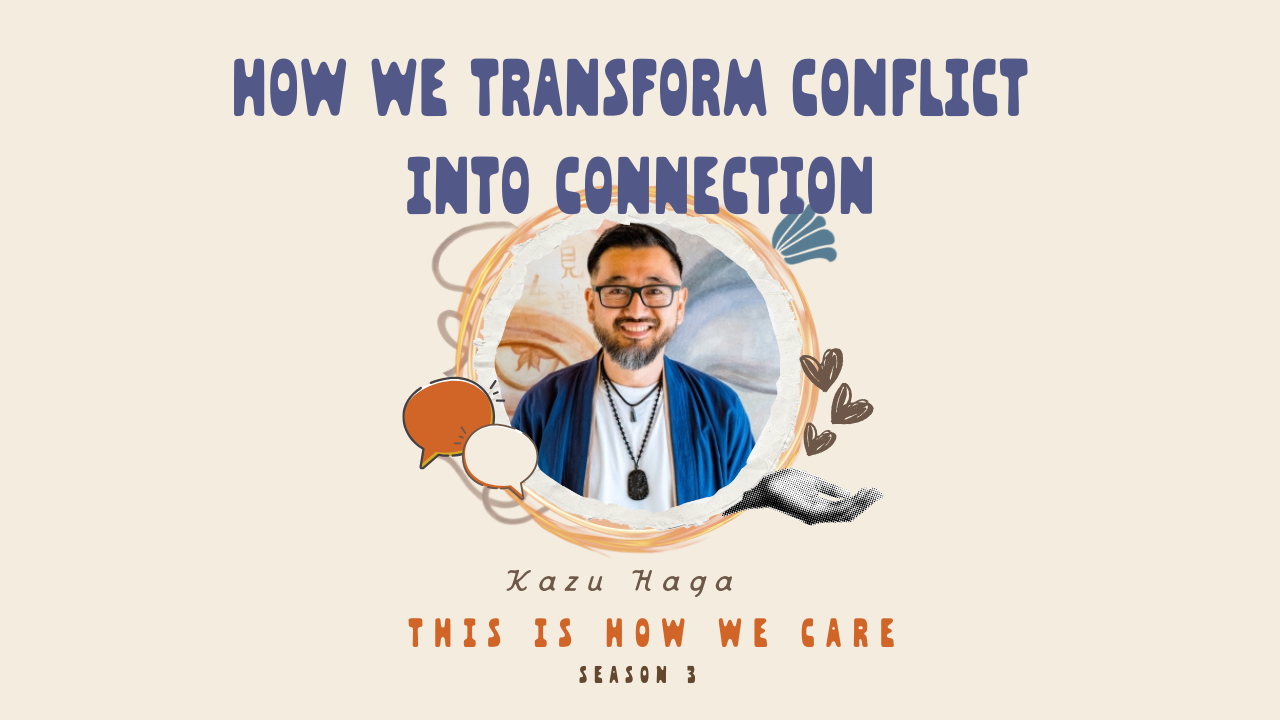
Collage image of Kazu Haga and the title of the episode “How We Transform Conflict into Connection”. Collage includes ring of fire, brown hearts, black & white hand, blue relationship icon, communication bubbles, and photo of Kazu.
In this conversation, Emily Race-Newmark (Revillaging Mama) and Kazu Haga explore the themes of nonviolence, community healing, and the importance of conflict as a regenerative force. They discuss the necessity of grief rituals for collective healing, the experience of living in an intentional community, and the various types and levels of conflict. Kazu emphasizes the significance of storytelling and listening in fostering compassion, as well as the need for collective spaces for grief and healing. The discussion also touches on rethinking accountability in the context of violence and the importance of emotional regulation in managing conflict.
FOR CONTINUED PRACTICE:
Check out Kazu's Fierce Vulnerability Kinship Lab: a 3 month intensive and other offerings on his website
Read Healing Resistance and Fierce Vulnerability by Kazu Haga
Join The Third Space! An online community for revillagers who are putting to practice what we learn on this show, together. In November we are exploring Relational Conflict.
TO STAY CONNECTED:
Follow @ThisIsHowWeCare and @RevillagingMama on Instagram
Follow @KazuHaga on Instagram and Substack Letters to Beloved Community
Transcript
Emily Race-Newmark (00:06):
Welcome to This Is How We Care, a podcast that explores what kind of world our children want to inherit and how we, the village raising them, can embody that world. Thank you for being here. I’m your host, Emily Race-Newmark.
Welcome to today’s episode. I’m so excited to share this one with you guys. I am recording, well, amidst a move. There are boxes all over. We’re settling into our new space, but I could not wait to get this episode out because we are actually exploring today’s topic in The Third Space, which is an online community for Revillagers. If you haven’t heard of The Third Space, I would love for you to check it out. It’s a place where we come together and practice and embody a lot of the topics that we discuss here on this podcast.
Today’s topic is one that explores how conflict is really an important part of what it means to be in community and how we can actually show up to conflict in ways that are regenerative rather than destructive.
Our guest for today is Kazu Haga, who is a trainer and a practitioner of nonviolence. This is a lens I wanted to bring into this conversation, knowing that we have so many examples of what violence looks like and what punishment looks like in our society.
As we’re imagining a different kind of world, I wanted to bring in someone whose voice could really speak to a world beyond violence. A world where conflict exists without harm and how we could start to bridge the gap between the world that we experience now to a world that we want our children to inherit skills, some new frameworks and a new context really to relate to conflict, and also to relate to harm when it does arise.
Kazu brings a lens around nonviolence, around restorative justice. He’s a core member of the Fierce Vulnerability Network, a core member of the Ahimsa Collective, the author of two amazing books, both which I have read.
One is called Healing Resistance: A Radically Different Response to Harm as well as, Fierce Vulnerability: Healing from Trauma, Emerging from Collapse. These are such great resources. You want to get them on your shelves, listen to them on audio book, if you like what Kazu has to say today.
Kazu’s lens is so valuable because he’s exploring these intersections of spiritual practice, trauma healing, and non-violent social change. So he’s really helping us meet the moment we are in, as well as imagining something beyond this moment, something that we would love our children to inherit.
Kazu is not just talking about this. You could say his whole life is in devotion to this work. He has over 25 years of experience in nonviolence and social change work. He’s also a resident of the Canticle Farm Community, and we talk a bit about his experience living there with his family in this intentional community.
Without further ado, I’m going to transition over to my conversation with Kazu. I hope you enjoy.
And if you do like what we talk about today, remember to check out the show notes for ways to engage with Kazu and some of the things that he’s up to, including a 3-month intensive around Fierce Vulnerability — that sounds amazing — if you want a deeper dive with Kazu himself.
And if you want to dive in right now, this month in November with The Third Space group we are exploring what it means to relate to conflict inside a community in regenerative ways, inspired by this conversation and so much more.
I hope to see you in The Third Space if that speaks to you. Enjoy the episode!
Emily Race-Newmark (03:14)
I have been so looking forward to sit here with you, Kazu, because this conversation we’re about to have has been really top of mind and heart for me. Thank you so much for joining us today and sharing the wisdom that I’m sure you’re going to share.
Kazu Haga (03:26)
Yeah, likewise. I’ve been looking forward to it.
Emily Race-Newmark (03:28)
I know there’s many stories but I would love for you to share a story that feels top of mind for you right now in terms of how you got to this moment in the movement that you’re leading right now.
Kazu Haga (03:37)
Yeah, mean, like you said, there’s so many stories, right? All of our lives are just a collection of stories. But the one moment in my life that I keep coming back to as I think about just how I ended up doing the work that I’m doing in this moment is, God, it was probably in 2012. I had already been doing nonviolence and social change work for, what, 12 years or maybe even longer up to that point. But this was at a time when I just started my own kind of personal inner healing journey.
And so I started looking at aspects of my childhood, just things that I’d gone through in my life that I felt like was still impacting me. And I attended this thing called the North American Leadership Jam. Jams are these like week-long gatherings put on by this organization called Yes. And it’s one of the safest spaces I’ve ever been to.
And this was my first jam. People were sharing really vulnerable things, you know? I decided during a gender fishbowl activity where those of us who identified as male were sitting in an inner circle and everyone else was sitting in the outer circle, I just decided to share something about an early childhood traumatic incident. And I decided to share it thinking that it wasn’t going to be that big of a deal. Like the story that I’ve been telling myself in my mind was this was a really scary thing that I experienced 20 years ago.
“I’m over it. Thank God it’s over. It’s not that big of a deal. I’ve quote unquote healed and moved on.” So I decided to share it. And the moment I started telling the story, I completely broke down and my body went into a state of panic. I could barely breathe. I could barely get a word out. And I was just crying and crying and crying.
I realized how delusional I was, just living in the state of delusion, thinking that just because this thing had happened 20 years ago, I’d gotten over it. I realized that that’s not how trauma works. I realized that these traumatic things stay frozen in your body, and until you can find a way to talk about it, to face it, to release it, to integrate it, to retroactively allow myself to feel the emotions that I wasn’t able to feel back then, then these stories and the fear and the shame gets frozen inside of you and it impacts everything that you do.
I’m thinking about this particular story because my work right now is really about learning to look at injustice less as a political issue and more as a manifestation of our collective trauma.
And looking at how trauma impacts us in fractals, that it impacts my body the same way that it impacts the collective body of the nation state we call the United States, and how in the United States, if we look at our early childhood traumas, like the enslavement of African peoples, and the genocide of indigenous peoples, and we have this tendency to be like, “that happened a hundred years ago. We’re over it.” I’m realizing more and more that collective healing, racial healing, healing from racial injustice and economic injustice, all of these things, involves going back and looking at our early collective childhood and finding ways to integrate it into our experience.
So I really think about that that moment as the the moment that really gave me insight into like, this is what it takes to heal.
Emily Race-Newmark (07:00)
My gosh, yeah, thank you. First of all, I actually can viscerally imagine that because I’ve been in circles like that before that are so powerful; the balance of witnessing and sharing and, your theory — that I think is really just fact — but this theory that we have a collective trauma body that we have to heal brought to a memory I had of going to a Holocaust memorial in Berlin where I was like, “wow, we actually like have a huge missed opportunity in United States to just memorialize what happened [on the land there] and to educate at the same time and to honor and pay tribute. “
I’m sharing that example because I’d love to hear from you, as someone who’s been thinking a lot about this, what do you actually think that looks like for us to take on this collective healing? What’s your vision for that?
Kazu Haga (07:45)
Yeah, well, I mean, you started mentioning a lot of the opportunities that are created by museums and memorials and things like that for collective grief. And I really, really believe in the power and the necessity of collective grief rituals. We see more and more of these grief rituals and grief ceremonies and things like that happening in kind of progressive spaces.
Part of my vision is that we take this grief work into more more public spaces.
Part of the work of fierce vulnerability that I’m imagining and that we’ve been working on trying to build is what if we use nonviolent direct action, not just as a way to like shut down an intersection and try to change legislation, but to actually take grief rituals into public spaces and give people who would never otherwise attend a grief ritual in some community space an opportunity to witness what it feels like to embody and to release the grief that as human beings we all hold.
And that’s a really tricky thing and it requires so much careful preparation and like spiritual and emotional training, right? To begin to try to imagine holding that space.
But yeah, a lot of the questions that we’re asking is what if we use nonviolent direct action not just as a way to change policy, but as a way to make people feel things, to feel the frozen emotions that are trapped inside of our bodies, and to use ceremony and art and ritual as a way to wake the nation up to a deeper reality.
Emily Race-Newmark (09:20)
Thank you for adding the ceremony ritual piece. That is a huge piece of it that I so resonate with. But also to pause, slow down, for folks who are like, “ooh, tell me more about this nonviolent direct action piece.” Can you define that for us for those who may not even really understand how to relate to that?
Kazu Haga (09:37)
Yeah, so in the course of my upbringing as a nonviolent activist, I’ve understood nonviolent direct action as tactics that we use to disobey the normalization of injustice and to put pressure on systems to try to cultivate people power to create change, right? So marches, demonstrations, acts of civil disobedience. Occupying government buildings, occupying public spaces, things like that.
Traditionally, I’ve understood it as a way to leverage power so that we can use power to create systemic change, right? To pass legislation, to change policies. I work a lot with incarcerated people and there’s a non-violence trainer who is incarcerated in Soledad State Prison here in California who once told me that resolving a conflict is about fixing issues and reconciling a conflict is about repairing relationships. And nonviolence at its best does both. Like we’re able to fix issues, to pass legislation, to change policies, to remove people out of places of power.
But if we’re not working to heal and strengthen the relationships between the communities who are at odds, then we’re always going to be spinning our wheels.
And so at some point, in addition to changing policies, we need to heal relationships.
We need to heal individual and collective trauma. And so that’s a little bit of what I’m thinking about when we think about using nonviolent direct action, not just as a way to fix issues, but how do we use it to heal relationships as well?
Emily Race-Newmark (10:53)
This may be a jump, but I think in your former book, there was a point around how our social activism actually is repeating some of the same behaviors of harm. And so is this actually like a similar thought around that, like that we’re just leading everything from action, action, action, and not integrating the need for healing space and ceremony and ritual space? Or can you connect those dots for me?
Kazu Haga (11:36)
Yeah, no, absolutely. My work is really just around understanding better and better the lineage of nonviolence and nonviolent activists like Martin Luther King and Cesar Chavez. I think they’ve always understood that their work is ultimately about healing. They talked about the importance of reconciliation and the importance of creating beloved community, which isn’t just about creating community with the people that you already love. It’s about cultivating compassion for those that we don’t love and for those that are challenging for us to be with.
But people like King, people like Gandhi, they didn’t have access to the science around neuroscience and trauma healing and all of the different modalities that we’ve developed for healing our traumas that we do today. And so the work that I’m doing right now is around integrating our understanding of trauma into nonviolent social change work.
And noticing in my own journey that, you know, even in many nonviolent movements, we use nonviolent tactics to try to shut down the other side and shove change down the throat of people who may disagree with us.
And we know through trauma healing work that it’s not effective to go to a person who is acting out of their trauma and to try to shut them down and say, you’re wrong. You need to do something differently. It might be effective in very, like, temporarily changing their behaviors because they’re afraid of you.
But ultimately in helping that person heal and really long-term sustainably changing their behaviors, it’s not going to be effective. But in a lot of our movements, we have this tendency to wave our fingers and say, “you are wrong. We need to shut you down and we’re going to shove change down your throat.”
I really believe that if our goal is healing and the creation of beloved community and reconciliation, then we need to be utilizing different tactics and different frameworks that understand that.
Harm develops out of trauma, harm develops out of harm, and what we need to do is to try to heal that harm.
Emily Race-Newmark (13:35)
Oh my gosh, I’m like really brought back to I was previously former life, where I used to do Diversity Equity Inclusion (DEI) facilitation inside of corporations. One of the reasons I stopped doing that, with my business partner at the time, was we felt like there is too much trauma in the room that is not getting addressed. And we actually are not equipped to like hold all of that in this like 30 minute, 60 minute workshop.
So I just wanted to share that anecdotally and see if you have a case study of what you’ve been seeing that’s actually really a powerful model of what could be.
Kazu Haga (14:03)
Yeah, mean, there are amazing people doing incredibly liberatory work under the umbrella of DEI. But I think DEI as a whole is an industry and it’s oftentimes looked at as like professional development, right? And it’s like this like intellectual activity. And I think the intention of DEI, which comes from critical race theory and all these things, to me, that work at its best is about healing the the racial trauma that everyone that grew up in this culture has, right, is deeply embodied in us.
And so yeah, it’s it’s not gonna happen through hour-long workshops. It’s not gonna happen through political and intellectual discussions. It’s gonna happen when we can actually slow down enough to notice what is arising in our bodies when we have conversations about racial healing?
You know, wherever you might be on the spectrum of power and privilege when it comes to race, it’s going to bring things up.
Can we slow down enough to actually create containers that feel safe enough for us to talk about the things that hurt?
My partner, LiZhen says that creating a safe container isn’t about creating containers where people don’t experience harm. It’s about creating containers where people feel safe enough to re-engage with the parts of the stories that hurt and to re-engage with the harm.
Can we actually have the courage to create these safe containers where we can talk about how much racial injustice has hurt all of us as a nation? My introduction to this work started when I was 17 years old with a project called the Interfaith Pilgrimage of the Middle Passage, where a group of 60 of us walked from Massachusetts down the coast of New Orleans, and then many of them continued on to Africa to retrace the slave route. And we would stop at sites of slave rebellions and slave auction sites and things like that and hold ritual and go into our collective grief. It was a really painful experience in a lot of ways, right? To really understand the history of the enslavement of African peoples from such an embodied perspective. But I think that’s the kind of healing that we need in this country.
Emily Race-Newmark (16:16)
When I read that story I felt something like, man, I just wish I could take part in something like that. But here I am in a stage of my life [as a mom of young kids] where I’m just sometimes trying to get by day to day. And so I asked this question from the lens of like, okay, what’s the vision for accessibility with this? Or is it not so much about meeting us where we are, but like inviting us into something that may feel challenging to arrive at? Is your vision to reach the masses with this? I’m imagining it is, from what you’re sharing. How do we get there?
Kazu Haga (16:45)
Yeah, mean, you know, all 300 million or however many people that live in the United States, they’re not all going to go on a walking pilgrimage that takes six months like that. But one of the great privileges of my life is that I was mentored by many people who worked very closely with Dr. Martin Luther King in the civil rights movement. And I asked him once, how many people who participated in the movement really believed in nonviolence, not just as a tactic and a strategy, but as a way of life? How many people were committed to healing? And he said that it was actually very few.
But most of the people who participated in the Civil Rights Movement understood that if we use nonviolent tactics of protest, then maybe we can change some pieces of legislation. But it was really important for the leadership of the movement to be really grounded in a much broader worldview of nonviolence.
And so I think it’s important for those of us who have the commitment, have the time, have the access, have the privilege, to really have these courageous conversations and deepen in an embodied understanding of what it takes to heal.
And I believe that the more and more people who are able to do that, just their presence alone, the presence of a regulated nervous system, the presence of a healed body, can change the field and can change what is accessible and can change what is possible in the people that are around that.
And so, you know, not everyone is going to go through like the deepest form of healing, but the more we can open up access points for people who are available, who are committed to that, I think can have these ripple effects that we might not even be able to imagine.
Emily Race-Newmark (18:11)
Thank you for refocusing that. It’s like we each have a different role to play is what I’m hearing there. And maybe there’s some of those who are listening to this who could step into that role of really embodying and holding the anchor of this is what’s possible. I’d love for you to speak to them right now; can you share a bit more around a present or a future that embodies nonviolence?
Does violence even exist in your ideal world? What does that future really look like? What are we trying to hold as possible?
Kazu Haga (18:59)
Yeah, I mean, there will certainly always be conflict in our lives, right? Nonviolence at the end of the day is really about learning how to respond to the conflicts in our lives in a way that gives it the best possible outcome.
One of my favorite quotes is from Sobonfu Somé who says, “Conflict is the spirit of the relationship asking itself to deepen.” conflict can result in an argument, it can result in fracture, it can result in war.
But it can also result in reconciliation and a deepened relationship and a strengthened relationship. And so I think there’s always going to be conflict, but how can we walk towards a world where we can see every conflict, not as a problem, but as an opportunity to learn something and deepen in relationship. And so what are the small ways that we can begin to practice that in our lives today? Like when we have a conflict with our partners, rather than just reacting from these emotions, can we just take a breath and slow down enough to notice what’s happening in our bodies and to take a pause and to speak from a place of just how am I feeling, how am I being impacted in this moment?
Can we slow down enough after the heat of the conflict to do some journaling about like, what was coming up for me? Another one of my favorite quotes is a quote from Reverend Angel Kydo Williams who says, “Did I traumatize you or did I bump into your trauma?”
Kazu Haga:
Oftentimes when someone does or says something that upsets us, we blame them and say the thing that you did or the thing that you said is what upset me.
But if we can slow down and look at our own internal environment, we oftentimes notice that actually the thing that they said triggered a much older wound than I was carrying long before they said that thing.
And if I can work to heal that, maybe the next time a similar comment is made, I won’t be so impacted. And so can we just continue to slow down in the conflicts that we experience day-to-day to notice what’s alive for us to notice what’s actually there? And these little ways that we contribute to the conflicts in our lives, I think, will have a larger and larger impact in what kind of world we’re creating.
Emily Race-Newmark (21:17)
There’s so much I want to ask you on this, but I do want to draw back that line to what you said at the start, before we recorded, that you actually live in a village right now. You live in a community — an intentional community. How are you all practicing some of this right now?
Kazu Haga (21:25)
Yeah, I do.
There are definitely things that are always not going well when you live in a community with 40 people. One of the greatest privileges of my life is I live as a resident of a community called Canticle Farms in Oakland on Ohlone Land. And we’re 11 homes, a tiny home and a yurt. We’re about 40 people, multiple generations. I think the youngest one right now is actually my daughter, who’s about to turn 15 and elders in their eighties.
We have people from every walk of life, formerly incarcerated people, people with millions of dollars of inherited wealth, people who can only speak ⁓ non-English languages, all trying to live together in this village and raise our children together.
The next door neighbors, the family that takes care of our daughter a couple times a month, the mother and the grandmother are monolingual Spanish speakers. And yet we share our lives together.
And it’s really hard when people from so many different cultural backgrounds, different life upbringings, are trying to live together in a village. But one thing that really helps is our shared commitment to nonviolence and restorative justice.
Right outside of my office here in the middle of our community, we have a restorative justice room, which is a room that is dedicated just for the use of restorative conflict engagement.
So you’re only allowed to be in that room if you’re in a conflict with someone and you’re trying to use nonviolent and restorative justice tools to try to come to some mutual understanding. And the room is in the center of the community and it has this big window that looks out onto the fire circle in the center of our community. And the idea behind the big window is that we should normalize conflict. And if you’re engaged in a conflict with someone, other people should see that you’re trying to work it out as a way to normalize the fact that we are constantly in conflict.
Emily Race-Newmark (23:00)
Wow.
Kazu Haga (23:23)
And it’s not whether or not we have conflict, it’s whether or not we’re committed to a process of coming back together into community once we’re in conflict, because the conflict is inevitable, right?
And so, yeah, my partner and I go in there once a week, every week, even if we have a conflict or not, just to check in. Like, “hey, in the past week, was there any moments of tension in our relationship that we didn’t get a chance to voice out loud?” And if not, here’s a place to do that.
And so I think these like small practices of really slowing down enough to say, like I thought it was your turn to do the dishes last night or whatever it is, again, really does create a field where we can get into more challenging conflicts and stay in connection through them.
Emily Race-Newmark (24:08)
I mean, what a contrast to the image of the nuclear family system where partners pretend that they don’t have any conflict or if they do its tersely done behind closed doors, not a window for display.
Yeah, that’s such a beautiful example. Thank you for sharing that.
Kazu Haga (24:16)
Totally.
Emily Race-Newmark (24:24)
I think maybe it’d be helpful to define for people the four main types of conflict. When I read that [in your book] it really grounded me in “okay, not all conflict is the same”, basically.
Do you mind defining or walking us through those kind of four main types and how we can relate to them?
Kazu Haga (24:39)
Yeah, totally.
So this is something I learned from the philosophy of Kingian Nonviolence which comes out of the teachings of Dr. King. And one of the main teachings that I learned from that is the idea that conflict is neutral, that it’s not a good or bad thing.
Things like yelling and arguing, those things aren’t signs of conflicts. They’re signs that a conflict has been mismanaged. It’s the outcome of a poor response to conflict.
So the more we can understand the conflict itself, the more tools we can have and the more ways we can think about how we respond to the conflict and the four major types of conflict is one way that we begin to understand what conflict looks like, what different types of conflict there are.
There’s pathway conflict, which is when two people have two or more goals, And we’re trying to get to the same place, but we have different ways of getting to the goal.
There’s mutual exclusive conflict when people have different goals. And because they have different goals, there’s an assumption that we can’t work on them both together at the same time that the goals are mutually exclusive, that you have to work on your thing over here. I have to work on my thing over here.
There’s distributive conflict, which is the perception that’s created that there’s not enough resources to go around, whether it’s time or money or attention.
And then there’s value-based conflict, which is just different values, different visions. And there’s a lot more to say about these four types of conflict.
You could do a whole two-day workshop just on the four types, but it’s useful like in village life sometimes, because sometimes when you’re living in community, you assume that you’re in a pathway conflict. Like, we’re all choosing to live in this village together, so we must all have the same goals and the same visions. But sometimes there are different goals and different visions that people have, and it’s important to be able to name, actually, we don’t have the same goal right now. We have different goals. But there’s still a way that we can function together so we can both get our goals met, right?
Emily Race-Newmark (26:18)
Yeah, that was actually like the thing that really was resonant for me as a facilitator too. It’s like, great, the reminder, “let’s make sure we’re talking about the same thing here” or “let’s clarify where we’re trying to head.”
That kind of goes back to what you said about slowing things down a bit. But you know, I’m really brought back to also this reminder that you shared in your book that this is a practice and it’s also not just a one-and-done practice or like a two day workshop practice. This is, it feels like, a lifelong practice.
Not to share that as like that’s a heavy lift and something that’s impossible, but how do you relate to nonviolence as an ongoing life practice? And what’s the invitation for people in that?
Kazu Haga (27:14)
Yeah, so It’s a little unfortunate because the English language has this word “practice” that makes it feel like if you’re like practicing for a school play or something.
And when we talk about non-violence practice, there’s a Japanese word that I think is a much better thing that I’m pointing to. The word is called 修行 and it’s literally translated as practice, but it’s not a word that you can use when you’re practicing for a basketball game.
When you talk about meditation practice, when you talk about yoga practice, when you talk about spiritual practice, it’s that kind of practice that we’re talking about with nonviolence. It’s not just like, how do I get better at shooting a basketball? But it’s about how do I align my daily life with the values that are most important to me?
It’s about understanding that we need to do something over and over and over thousands of times for it to become an embodied thing, for it to become our new default. And so many of us grow up thinking that conflict is a bad thing. So whenever there’s a conflict in our lives, we react by fighting or running away. And it takes thousands of times to practice having our default response to conflict be something different, right?
And so whether it’s me and my partner going to the RJ [restorative justice] room every single week and checking in to see if there’s any tension in our bodies or using things like nonviolent communication to try to express our feelings and our needs as opposed to accusations about what the other person is doing or every time I’m in a conflict and I can notice, “I thought this was a pathway conflict, but this is actually a distributive conflict. So let me respond to it in this way.”
Every time we practice nonviolence, we’re building our muscles and growing our capacity to practice nonviolence on a day to day basis.
Similar to karate or meditation, no one’s ever gone to a two day karate seminar and walked away feeling like they understand what karate is and they no longer need to practice it. If you have a martial arts practice, you practice two, three, four, five times a week. And so similarly with nonviolence, it’s something that we really try to encourage people to find ways to practice it as often as they can so that they’re constantly building their muscles for it.
Emily Race-Newmark (29:17)
All right.
So, you one thing we skipped over, but I do want to focus on here, is not just your vision for all these different things we touched on, but through the lens of our future generations. You have a daughter, I have children, people listening here are caregivers of some kind and we’re thinking about “what kind of world are these children inheriting?” And how can we kind of model that for them now?
So you’re touching on a lot. I mean, they’re inheriting a world that’s full of collective trauma. Maybe it’s not their own, but they’re inheriting that. And they’re inheriting a world that is violent.
What is your vision for the world and who we need to be?
Kazu Haga (30:08)
I feel like so much of the root of violence is the delusion of separation and the delusion of individualism.
Like the moment that I see those people as “those people” and somehow separate from the interwoven web of life that exists, the moment I start thinking about I can gain something by harming those people “over there.”
That’s the root of violence. And not just because I’m able to prepare myself to inflict harm on those people, but because if “those people” are not part of the interwoven web of relationships and of life and of interdependence, if I can imagine any group of people as outside of the web of interdependence, then there’s part of me that is afraid that at some point I might get kicked out of the web of interdependence.
And so I think the work of universal belonging for me to have this unwavering faith that no matter what happens to me, no matter what I do, I am a part of this cosmos. I am deeply interwoven with every other life form on this planet. And if I can have that belief in a deeply embodied way, then perhaps I won’t feel threatened to kick somebody else out of that web of life.
The vision that I have for the world that I want my child to inherit is a world where every single person deeply feels that sense of belonging and that they are deeply an interwoven part of the community that they live in and the planet that they live in, right?
That there is no separation between them and their family and the village that we live in. There’s no separation between them and the natural resources that are part of our lives. And to really understand that sense of connection and interdependence as the essence of who we are.
Emily Race-Newmark (32:10)
Yeah, I’m like thinking about, yes, that’s one thing that’s easy to practice when those people align with our values, or have an overlap in the Venn Diagram.
And then the challenge that that is to practice is when it’s someone or a group of people that seems to almost go against, you know, our own safety or our sense of value. So I know you mentioned that that’s also like a part of this practice, but how do we model that and how have you practiced that personally?
Kazu Haga (32:38)
I share that I work a lot with incarcerated people and a lot of them have caused incredible harm and have had at times in their lives worldviews that I vehemently disagree with.
And one of the things that I’ve discovered in my life working with incarcerated people — I also used to spend I spent 10 years working in philanthropy. So I spent a lot of time with wealthy people and philanthropists.
I found that every single time that I’ve had the opportunity to slow down and listen to somebody’s story, then everything they do and everything they’ve done, everything they believe begins to make sense to me. It doesn’t justify or condone the things that they do or believe, but it begins to make sense, right?
And so I think the magic of story — can we slow down enough to lead with curiosity about why a person is doing what they’re doing, why a person believes what they do? And if we can really ask, questions and really take in their stories, I think it begins to get a lot easier to hold compassion and to see the similarities in our stories.
One of my favorite definitions of violence comes from Marshall Rosenberg, the founder of Nonviolent Communication. And he said, “violence is the tragic expression of unmet needs”, that we all have these universal needs that are all shared.
Like we all have the same universal needs for connection and purpose and physical safety and all these things.And when those needs are not met, oftentimes we choose tragic strategies to try to get those needs met.
So if I have a need to be heard, that’s not being met, I might scream at you. And that’s a tragic expression of this universal need to be heard, right? And so I’ve noticed that if we can slow down enough, not just understand someone’s story, but specifically to understand people’s pain points, those pain points are so universal and so shared.
And so I think that’s one thing I really encourage people is just to slow down and lead with curiosity.
Emily Race-Newmark (34:37)
Yeah, so that’s like my life mantra and also a challenge in a world that moves so quickly. Part of that for me is the slowing down part, but then the other part, which is implied in what you’re saying is like putting ourselves in the situations to hear the story, versus a lot of this divisive, “faux relationship”of social media. Here you are putting yourself in environments where you’re actually going to be confronted with a perspective that might challenge your own.
I could say, “I’ll just go out in my neighborhood and maybe I’ll be met with some of those different experiences”. Are there other ways that you think folks can start to break the barriers of separation?
Kazu Haga (35:14)
Totally.
Yeah. So you may know that I spend a lot of my time listening to conservative podcasts and reading conservative articles. And those are helpful for me because it’s less triggering because the person isn’t right in front of my face and it’s a little bit more removed. So I see that as like training grounds. Like I’m going into the dojo to increase my capacity to hear perspectives that I disagree with.
I’m also a big fan of two media projects. One is called Braver Angels. Well, Braver Angels is more than a media project, but they’re an organization that supports dialogues across differences. If you’re on the political left, they’ll actually connect you with an individual person who’s on the political right that wants to have connections.
And then there’s a YouTube channel that I recently discovered called The Enemies Project. And it’s by a longtime mediator who brings two people together across very different belief systems and actually sits down with them and invites stories and pain points from both of them to really help the two sides understand each other.
I like debate shows and stuff too, debates are helpful, but it’s also about trying to convince the other side that you’re right. Whereas things like The Enemies Project is just about listening to the other side and seeing what common ground you can find. So I really encourage people to check those resources out.
Emily Race-Newmark (36:07)
In those practices of listening to perspectives that may “bump into our trauma” what are some of the skills, the tools that we need to start to learn?
You can answer this from like an interpersonal level, but also institutional level; let’s hear a vision for how even education can shift to like start to account for the very real practical skills that we need to learn to hold this within ourselves and each other.
Kazu Haga (36:57)
Yeah. So, in the new book that I just wrote, I talk about short-term training practices, medium term and long-term.
I think short-term is just practicing emotional regulation tools like deep breathing and like everyone knows about deep breathing and how it can regulate our nervous system.
But there’s little things like a lot of people don’t know that deep inhales is actually connected to the part of our nervous system that can keep us in a state of panic. It’s the deep slow exhales that regulates our nervous system and begins to slow us down.
Oftentimes when we’re in a state of panic and you tell someone, “just take a deep breath”, they’ll breathe like this — I don’t know if you’re going to be able to hear it through the mic, but they’ll breathe like, [deep inhale, short exhale] right? That’s what deep panic breathing sounds like. It’s these deep, long inhales and really fast exhales.
And so if we’re not practicing, deep, slow exhales, we enter a state of panic. When we’re in a state of panic and we try to breathe deep, we might not be breathing in a way that actually helps slow down our nervous system.
So practicing breathing. We all feel like we know how to breathe because we’ve been breathing our entire lives. But if we’re not practicing the right kind of breathing in the moment that you need it the most, you might not be breathing in a way that helps you slow down.
Learning that when you’re in a state of panic, just taking a sip of water or getting a bite to eat can also regulate your nervous system. There’s all these things that you can do to help regulate your nervous system that are relatively easy to practice.
And then in the medium term, finding spaces to really express and honor our grief and our rage and these really difficult, big emotions that we oftentimes hold on to that we don’t always have good spaces to release.
And then in the long term for each of us to really commit to our long term trauma healing journey, whether that’s through going to collective group spaces like jams or individual therapy or access to nature or whatever it might be, finding ways that we can really integrate a lot of the old childhood traumas that we all hold because all of that when it’s unintegrated has a huge impact on our ability to slow down and invite curiosity in this moment.
Emily Race-Newmark (39:26)
Yeah, on that point, I’m really curious — because I think some of our audience here are people who are building community in their own backyards and they may feel a call, as I do often, to bring people together for that grieving process or to have that cathartic release together. And then what comes up for me is, “well, am I the one to do this or responsibly, right?” Like what actually needs to create that safety container?
What are what are some of the things we should be looking for to know that a space actually can hold that intention?
Kazu Haga (39:55)
Totally. I think it’s largely people who have done it before, right, and know how to do it, and have kind of processed their own grief so that they have space to hold the grief of other people.
This work is not that different from performing an operation on somebody. It’s easy to cut somebody open, but it takes a lot of skill to know what to do once that wound is cut open and to be able to stitch it back up properly.
And so there’s a lot of organizations like the Faith Matters Network or the Good Grief Network or The Work That Reconnects that train people on how to hold this kind of space. we need to normalize this work and make it more more accessible. And as we do that, to really honor the sanctity of this work and to know that you don’t have to pay hundreds of thousands of dollars and get a fancy degree to do it.
The skills are already available in our own communities. And it takes careful training and container setting to be able to create containers where people can walk away feeling like they actually unburdened something, not just that they open something up and now they’re walking around with this wide open wound.
Emily Race-Newmark (41:03)
For sure. Yeah, there was a story I read of yours where you were facilitating something within your own family system, which like I really bow down to you for that. I think that takes like a next-level of martial artistry to do. But one of the things that you were leaning on there was not just relying on the facilitator. You mentioned that if a facilitator is not present, or in your case, a facilitator who may not be able to be present, what’s the kind of structure to hold that space? Can you speak to that? Because I think that’s something that’s also really accessible to people.
Kazu Haga (41:35)
Totally.
Yeah, just to name that it took me eight years of preparation to get to that conversation. But yeah, there’s a tool that I learned from a teacher named Miki Kashtan that I really value, that I adapted a little bit. And it’s a Venn diagram between relationship, skill, and structure.
My assessment is that to have any difficult conversation, you really need a good amount of at least two of those three things.
So how close is the relationship you have with the people that you’re holding space for or that you’re in conflict with?
How much skill do the people have in engaging in these difficult conversations and how structured is the conversation?
And if you really assess like, how much relationship skill and structure is there?
And you notice that you have a deep relationship with the people that you want to talk to, but there’s no skill or structure, then maybe you can invite a skilled facilitator to bring some of the skill into the conversation.
Or you can use a structure as something as simple as a talking circle where you pass around a talking stick and only one person is able to speak at a time and you’re not allowed to interrupt each other. That introduces some structure that can support the conversation.
Assessing how much skill is there, how much relationship, how much structure is there.
And if, you know, more than two of those things are missing, what are ways that we can bring in, increase the relationship, increase the structure, increase the skill in that conversation?
Emily Race-Newmark (43:01)
Yeah, to hone in on the increasing relationship, like, oof, I think of the number times I’ve assumed or I’ve seen it be assumed that relationship is present when it’s not. What is that journey of really even assessing like where a relationship is at? Is it just a simple check-in or how would you navigate that?
Kazu Haga (43:21)
I remember — this was a bit of an aside, but years ago I was designing a workshop with my friend Sonia and I went to her house to plan the agenda. We had a meeting set and I got to her house. I sat down at her table and I opened up the computer and I was like, “all right, so I had some ideas for the agenda and blah, blah”. And she stopped me and she was like, “oh, hold on a second. How are you doing? Like, let’s start there.”
And it’s not that I didn’t have a relationship with Sonia. I had already known her for years at that point. You know, I consider her a close friend.
But like, what do we really mean by the word relationship? What do I really mean when I say like, do I know Sonia? Do I actually know how she’s doing in this moment? Like how is her life? How is her relationships?
I think because of the fast paced nature of our, of our lives today, we oftentimes don’t have the opportunity to slow down and say, “Hey, how are you actually doing? Like, I actually want to know who you are in this moment. I might know that you have these siblings and you grew up in this place, but like, who are you in this moment? How are you really doing?”
I think without the time to really have those conversations, like who do we really know? How many people do we really know?
Especially if you’re going to enter into a conversation around grief or conflict or something, that relationship of like, who are you in this moment? What else are you holding in your life that might contribute to the conflicts and the tension that we have? Those conversations are really important. So, you know, if the relationship structure and skill isn’t there, maybe before diving into the conflict or diving into the grief work, slowing down a check in and say, hey, how are you doing in this moment?
Emily Race-Newmark (44:57)
Which it reminds me — and forgive me if is this is this under the bucket of restorative justice principles or not — but just the idea of when there has been harm inflicted and there’s like one person that’s kind of the perpetrator of that harm that rather than just starting with like the accusations of what you did, there’s a process of checking where have they experienced harm first? Is that am I remembering that correctly?
Kazu Haga (45:19)
No, absolutely. And a lot of the restorative justice work I’ve done with incarcerated people who have been convicted and they’re not saying that they’re innocent or anything. We rarely start with the crime that they committed. It’s much more healing if we start with who they are and what happened in their life that led up to that moment. Because then we begin to see them not just as the sum of the worst thing that they did, but the totality of who they are as a human being. And I think once they can feel like they are witnessed as much more than just a criminal, then they’re able to trust the space more to really go into a deep process of healing and accountability.
Emily Race-Newmark (45:59)
Yeah, knowing that our current system culture right now is one of a lot of incarceration and a prison system that, I think needs to be abolished. What is your take on a vision for all of that, right? How we would deal with harm in our communities?
Kazu Haga (46:16)
I think one of the problems that happens in our society is we conflate accountability with punishment. Like to hold someone accountable means to cause the same amount of harm to that person than that person committed.
And to me, punishment is the opposite of accountability, right?
I didn’t know what the word accountability meant until I started working with these incarcerated people who have committed incredible harm and witnessed them go through their journey of healing and transformation. And I’ve discovered that accountability at its best is an act of love that we offer to the person that caused harm because it’s a part of their healing journey.
And so in terms of my vision for a society and how we respond to harm and how we respond to violence, it’s to acknowledge that — I love quotes. One of my favorite quotes again, comes from a transformative justice activist named Mariame Kaba, who said that “nobody enters violence for the first time by committing it.” We all experience violence first as survivors. And then the pain that we kind of embody from that incident of violence, because it’s not always able to be fully integrated, we lash out and harm other people.
And so can we create a culture and a society that understands that that is the root of violence? And again, to slow down enough to give the person that caused harm time to understand and have the insight as to what happened in their lives that led up to that moment. And can we unpack that?
And from that place, can that person begin to feel a sense of remorse for the harm that they caused and to begin a healing journey from that?
Emily Race-Newmark (48:06)
Yeah, and it’s like as someone who’s been really trained in listening, what I hear in that is that process of beginning with the human being first actually shifts the listening of everybody there in that space where I’m now listening to you as a human versus listening to you as a wrongdoer. And that maybe even allows that person sharing to hear themselves as that, to remember who they are, which is such a powerful gift. Yeah.
Kazu Haga (48:21)
Yeah, and our criminal justice system today has no space for listening, particularly to the person that caused the harm, but really to either side, right? It’s like our criminal justice system, when harm happens, both the person that caused the harm and the person who experienced the harm, they have no voice. Like the whole system is like this runaway system where the judges and the lawyers have all the power and the voice. And the people that are most directly impacted have no voice in what happens.
And it’s like, who designed this?
Emily Race-Newmark (48:38)
Right.
Wow. My gosh, it’s such a good point. That’s just maddening.
Yeah, I actually think through the lens of, from what I’ve heard of people who move through divorce, that that’s often the issue that happens is what could be actually a really beautiful relational-led untethering, the minute lawyers get involved, everything kind of gets inflamed and it’s almost like speaks to our cultural tendency to just lean into —I mean, not just conflict, as you said, conflict is normal. But what is that inflammation that I’m speaking about? There’s different layers of conflict, right? There’s different levels to how we would experience it?
Kazu Haga (49:36)
Yeah, I mean, in addition to the four major types of conflict in Kingian Nonviolence, we talk about something called the three levels of conflict. And it’s important to understand too, because responding to a really escalated level of conflict requires different tactics and strategies than a low intensity level of conflict.
So beginning to understand the warning signs and the escalation signs so that we can think through our responses to conflict a little.
Emily Race-Newmark
What are some of those warning signs just so we can name them?
Kazu Haga (50:04)
The three levels of conflict is normal, pervasive and overt.
The normal level of conflict is just like the small conflicts that we experience every single day in our lives. And as these conflicts add up, they begin to escalate. So our muscles begin to tighten, our voices begins to rise, or some people stop talking. We start calling each other names. We start fidgeting a lot more. We can notice our heart rate increasing.
And all of these are signs that a conflict is beginning to escalate. And so a strategy that might have been effective just at the normal level of conflict might not be effective anymore.
And so when we’re training to respond to conflict, trying to identify what level it’s at, and then finding the appropriate responses to those conflict is really important.
Emily Race-Newmark (50:40)
For one that escalates to over, what is the right intervention for that, for an everyday person?
Kazu Haga (50:58)
If it rises to the level of violent physical conflict, you might actually have to use physical force to pull the two people apart and at least try to de-escalate the conflict back into a pervasive level of conflict so you can actually talk to the people. But sometimes you might need to use that physical force, right? There are, of course, lots of stories that I’ve heard of people breaking up fights by singing songs and like doing something completely silly and unexpected in front of the two people that are fighting. And it kind of like confuses them. And in that moment of confusion, you can actually connect with that person. So there’s always nonviolent ways, but yeah, as the conflict begins to escalate, have to really like escalate the tactics that we use.
Emily Race-Newmark (51:42)
Right, exactly.
Well, there’s so much more we could talk about. As you said, there’s like full workshops that we be had out of this conversation, but I want to now ground us in for listeners who are hearing all of this, maybe feeling even scattered on like, :where do I begin” or “how do I start to integrate this conversation?” Do you have an invitation for just one simple practice that folks could walk away with?
Kazu Haga (52:04)
Yeah, I I really love the practice of conflict journaling because all of this stuff is like, it’s easier to think about, but then when you’re in the heat of the conflict, unless again, you’ve been practicing it for years and years, it’s really hard to put into practice.
But once the immediate conflict dies down, once you’re no longer like near the person that you were in conflict with, just to do some journaling around it, like what happened? At what point in the conflict do you feel like you escalated? And what was that pain point from? Was it touching on something older? What of the four major types of conflict were you in? How else might you have responded to it?
And to really begin to think about, OK, next time I communicate with this person, here’s the essence of what I want to think that kind of debriefing from a conflict and thinking about it afterwards can you a lot of insight.
Emily Race-Newmark (52:55)
Yes, beautiful, like being your own mirror for what just happened there.
Well, Kazu thank you so much for just who you are in the world, what you are leading by example, and for the wisdom that you did share in this conversation. was something that I’m gonna walk away with bringing back into my own family, my own community, and I hope that others do the same. So thank you.
Kazu Haga (52:58)
Totally. Thank you so much for having me.
Emily Race-Newmark (53:14)
That was such an amazing conversation. I hope you enjoyed it as much as I did. It left me with so much to think about and again, to practice which is one of the reasons why we’re focusing on “Relational Conflict” in The Third Space right now.
Again, that’s a virtual gathering space for Revillagers — people like you and I who want to bring to life so much of the conversations we’re having here on This Is How We Care but you want to do that in a communal way, you want to do that with shared accountability, you want to do that with people who are practicing these ideas in their communitie.
Check out The Third Space and for more information around what Kazu’s up to his work how to purchases books, and upcoming events you want to work with him in a deeper way, you can find all of that over at the show notes for this episode. Go to thisishowwecare.substack.com And there you can find the transcript for this episode, show notes and more.
Again, thank you for being here. Your listening, your time as a valuable resource means so much to us.
May you take the conversations that speak to you and bring them into being through who you are being in the world.
Take care.
TIMESTAMPS:
00:00 The Journey to Healing and Social Change
06:17 Collective Trauma and Grief Rituals
08:46 Nonviolent Direct Action and Healing Relationships
11:35 Integrating Trauma into Activism
14:02 Creating Safe Spaces for Racial Healing
16:54 The Role of Community in Conflict Resolution
19:26 Understanding Conflict Types
22:26 Practicing Nonviolence in Daily Life
28:03 Practicing Nonviolence: Building New Defaults
30:17 Vision for Future Generations: A World of Belonging
32:33 Understanding Conflict: The Role of Storytelling
36:22 Tools for Emotional Regulation and Healing
39:53 Creating Safe Spaces for Grief and Healing
42:00 Facilitating Difficult Conversations: Skills and Structures
45:58 Rethinking Accountability: From Punishment to Healing
49:35 Navigating Conflict: Understanding Levels and Responses
52:03 Conflict Journaling: A Practice for Reflection